Zero-knowledge in Tamga: Longfellow, circuits, trust list
How Tamga Network checks "over 18" with a Longfellow zero-knowledge proof, why circuits sit in the signed trust list, and what works today.
Tamga Network 10 min read
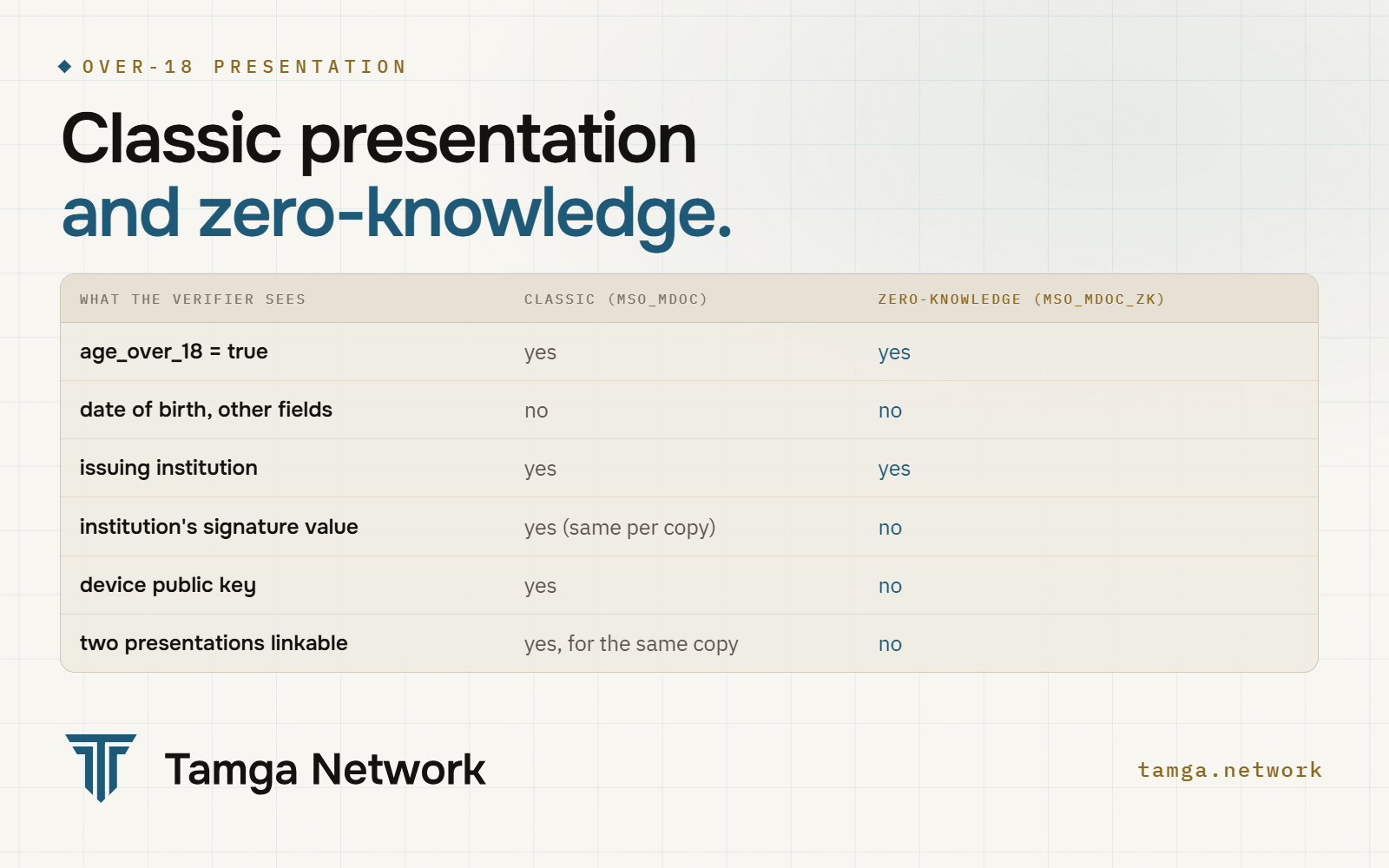
A zero-knowledge proof lets a wallet prove a statement about a credential, such as "this person is over 18", without showing the credential itself. In Tamga Network the verifier learns only that a registered institution's identity credential says age_over_18 = true. It does not see the date of birth, the other fields, the institution's signature or the device key, and two presentations by the same person cannot be linked. Tamga uses Longfellow ZK over the institution's existing ISO mdoc credential, so the institution changes nothing. The verifier side is live on Tamga Verify (policy age-over-18-zk); the accepted proof circuits are published in the signed trust list; on the wallet side the Android native library is ready and the iOS library is pending.
What does the proof actually prove?
A classic presentation of an over-18 attribute already hides the date of birth: the wallet discloses one field, age_over_18, and nothing else. What it cannot hide is the institution's signature over that field, and that signature is identical every time the same copy is shown. Tamga issues every credential as 10 copies so that different verifiers see different signatures. That works, but copies run out and must be refreshed.
A zero-knowledge proof removes the signature from view altogether. The wallet runs a computation over the credential it holds and produces a proof that the computation came out right. With Longfellow circuit version 8, the proof binds:
- the institution's public key, which the verifier matches against the trust list;
- the credential type (the mdoc docType);
- the attribute name and its value, here
age_over_18andtrue; - a signature by the device key over this session's transcript, so the proof is tied to this verifier and this request, while the device public key itself stays hidden;
- the validity of the credential at the time of proving.
What it does not bind is the namespace inside the credential. A proof says "in this institution's credential of this type, some namespace has age_over_18 = true". Tamga closes that gap with a catalogue rule: within one credential type, an attribute name may appear in only one namespace, and the schema catalogue checks this when it is built (rule ZK6).
Why Longfellow ZK?
Several approaches exist. The deciding question for Tamga was whether institutions would have to change how they sign. The decision record weighs them (ADR-0032):
| Option | Outcome | Why |
|---|---|---|
| Longfellow ZK | accepted | institutions keep their ES256 mdoc signatures; no trusted setup; open source; independently reviewed; the EU's age-verification work builds on it |
| BBS signatures | rejected | institutions would have to change keys and signature format; not on the EU's approved list |
| Batch copies only | kept as fallback | works today, but copies run out and the signature repeats per copy |
Longfellow ZK proves statements about ECDSA-signed mdoc credentials. It was released as open source under Apache-2.0 (announcement), is described in the paper Anonymous credentials from ECDSA, and has completed several independent security reviews. It needs no trusted setup, so there is no secret ceremony that someone would have to be trusted to have destroyed. The EU's draft technical specification for arithmetic-circuit proofs in wallets, TS13, is written around the same approach and is still exploratory; its further work moves to ETSI.
Why are circuits listed in the signed trust list?
A circuit is the program the proof is about. A verifier that accepted any circuit could be shown a proof of something other than what it asked for. So a Tamga verifier accepts only circuits that the network has reviewed and published by their digest, with status ACTIVE, in the signed list of trusted lists. An unknown or inactive circuit is rejected (rule ZK2).
This is the live entry on 8 October 2026:
{
  "circuit_id": "5a8938159603876eb537a117cfe9e2eaec5a01a042b316a8e57e52e4bb3c9291",
  "system": "longfellow-libzk-v1",
  "version": 8,
  "attributes": 1,
  "sha256": "f44ab1a415f284251ea6ad5451d2588c1e7011eb9ba46091116e8caa4c8e0d83",
  "status": "ACTIVE"
}
The circuit file itself is published next to the lists at trust.tamga.network/zk/<circuit_id>.zst, about 300 KB, and contains no personal data. A wallet can ship it inside the app or download it; either way it checks the file against the sha256 in the signed list before use, so where the file came from does not change what is trusted. We checked the published file against the list on the date above, and the digests match.
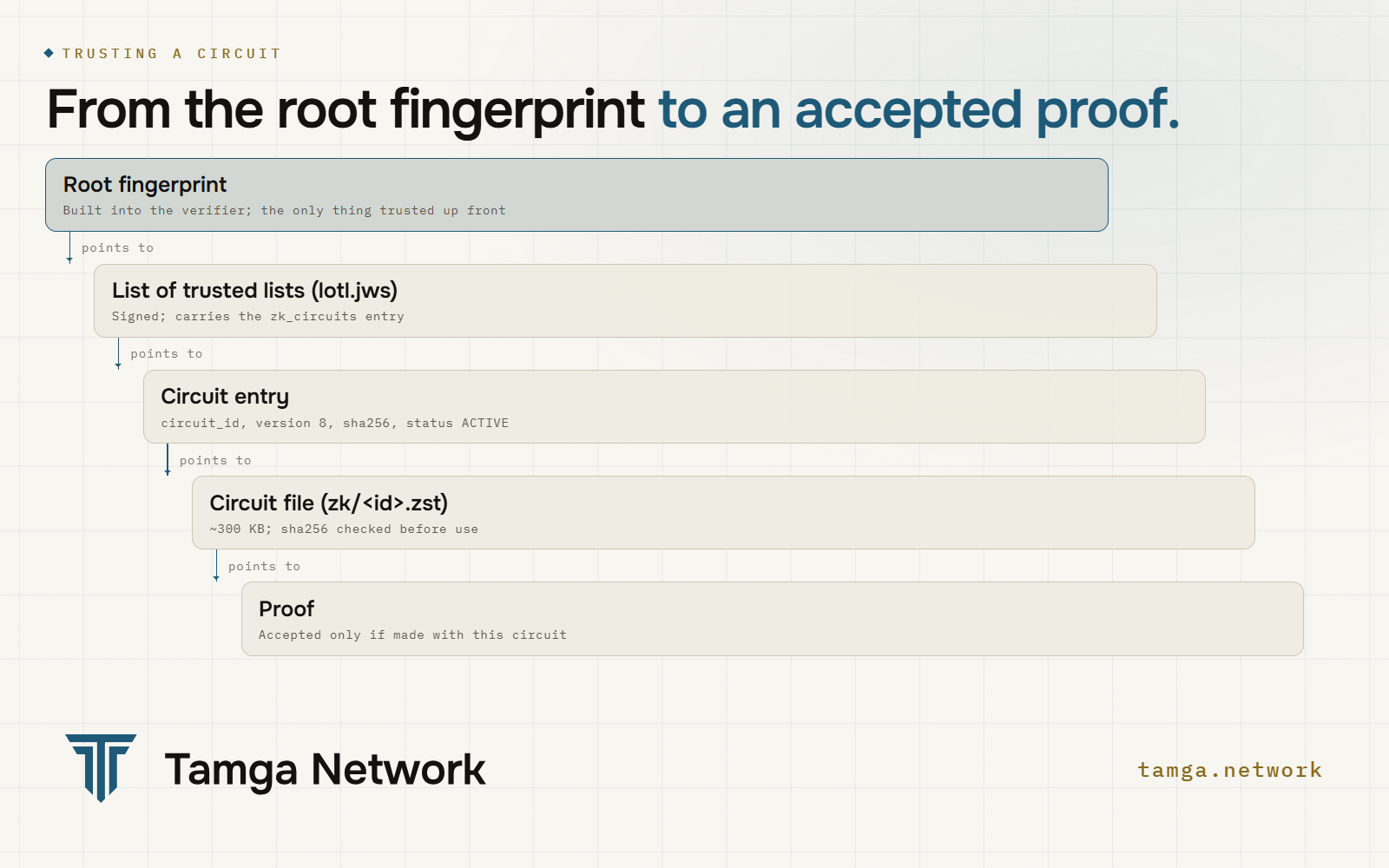
A circuit update is a list update. It does not need a new architecture decision, but it is published as a new signed list version and recorded in the public change log, like any other change to the list (How a signed trust list works).
How does a verifier check a proof?
The verifier package compiles only Longfellow's verification code to WebAssembly. The module is 889 KB, has no external dependencies, is built from a pinned upstream commit and can be rebuilt reproducibly. A verification takes about 3 seconds on a desktop in WebAssembly. For high volume there is a native backend built from the same source that takes about 0.2 to 0.3 seconds; Tamga Verify uses it and falls back to WebAssembly if the native process does not answer. An error on either path never counts as "valid".
In the verification pipeline this is step Z1. It asks four things: is the circuit in the signed list and does the file digest match; were only the requested elements disclosed, from one namespace; is the timestamp within its window; is the proof valid. The usual checks of the institution signature, the device signature and the validity period run inside the proof. Before Z1 the verifier still decodes the response, checks the docType, and reads the institution's certificate chain to find the institution in the trust list (verification API).
When is the result INDETERMINATE and when REJECTED?
Tamga keeps the three-valued result for zero-knowledge too: a credential is never called fake because something on the verifier's side was missing.
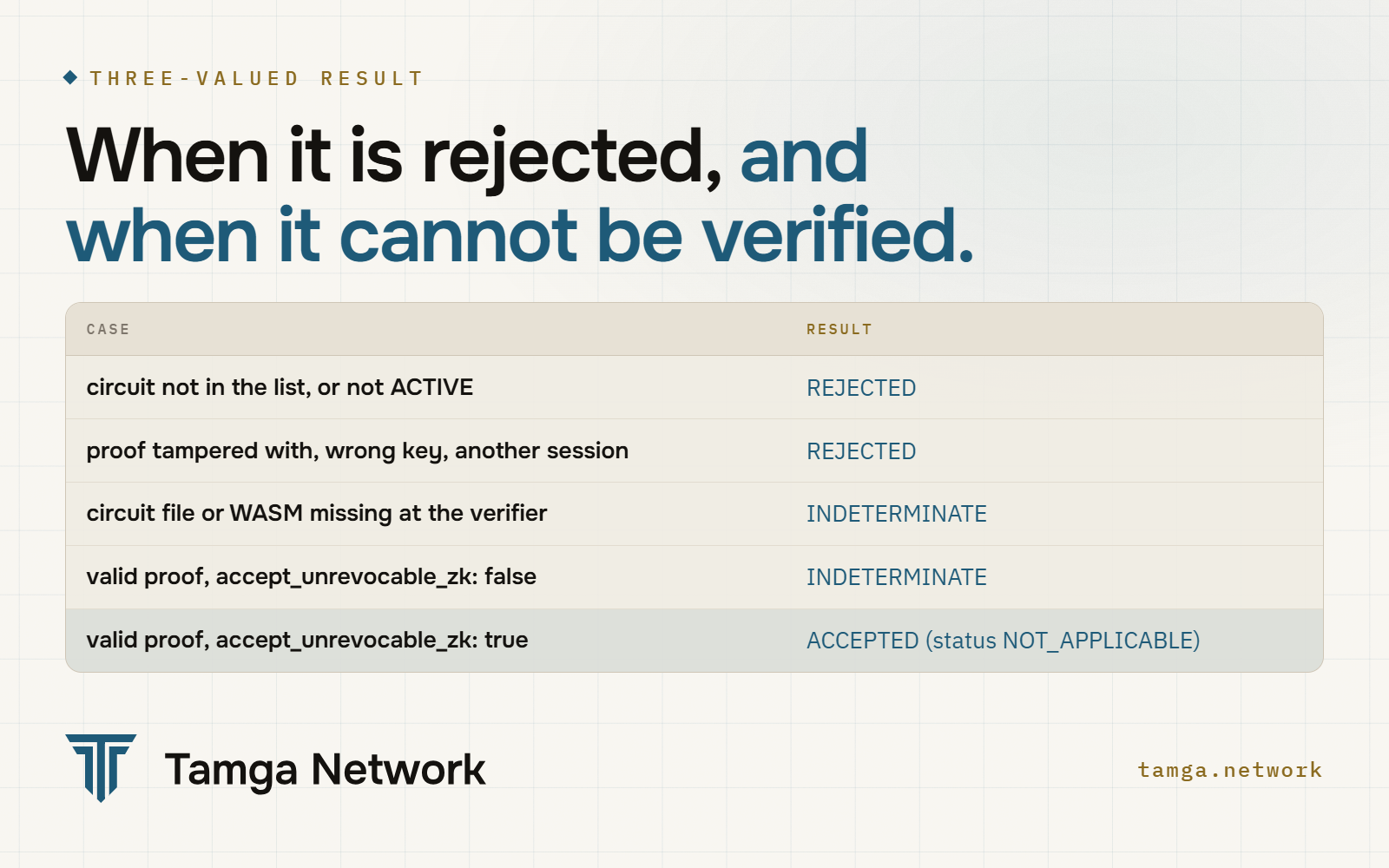
| Case | Result |
|---|---|
Circuit not in the signed list, or not ACTIVE | REJECTED |
| Proof tampered with, wrong institution key, another session or another verifier | REJECTED |
| Circuit file or WebAssembly missing on the verifier's side | INDETERMINATE (SDK_VERSION_MISMATCH) |
Valid proof, policy has accept_unrevocable_zk: false | INDETERMINATE (STATUS_UNREACHABLE) |
Valid proof, policy has accept_unrevocable_zk: true | ACCEPTED, status NOT_APPLICABLE with a reason |
The rejections in the second row were tested on purpose in the first desktop trial: a changed value, a wrong institution key, another session's nonce, another verifier, "true" claimed from a credential that said "false", another docType and a corrupted proof all failed.
Why can a zero-knowledge presentation not show revocation?
To check revocation, the verifier needs the credential's position in the institution's status list. That position is fixed per credential, so revealing it would make two presentations linkable again, which is the very thing the proof is meant to prevent. The circuit therefore does not check revocation (rule ZK4).
Tamga's interim answer has two parts. The rules call for credentials presented this way to be short-lived, so that a revoked credential stops being usable soon (ZK4). And the verifier's policy must say explicitly whether it accepts a presentation whose revocation cannot be checked:
const policy: Policy = {
  policy_id: "age-over-18-zk",
  purpose: { "en-US": "Over-18 check, yes/no only" },
  credentials: [{
    id: "identity",
    vct_values: ["urn:tamga:id:IdentityAttestation:1"],
    format: "mso_mdoc_zk",
    namespace: "tamga.id.1",
    required_claims: ["age_over_18"],
    constraints: { age_over_18: true }, // equality only
    accept_unrevocable_zk: true,        // knowingly accept: revocation cannot be checked
  }],
  trust: { /* … */ },
  freshness: { /* … */ },
};
A site where revocation must be checked uses the classic mso_mdoc policy instead. A private revocation proof will get its own decision once the EU settles the revocation scheme for TS13.
How does a site ask for a proof?
The request uses OpenID4VP with a DCQL query whose format is mso_mdoc_zk, as in TS13; the browser Digital Credentials API is the second transport (ready on the verifier side; wallets are not connected to it yet). A proof is about 350 KB, so it cannot be carried in a QR code. For in-person checks over Bluetooth, the decision waits for on-device measurements.
On Tamga Verify the zero-knowledge and classic checks are two separate policies, both listed at verify.tamga.network/policies: age-over-18-zk and age-over-18-mdoc. If the person's wallet cannot produce a proof, the site can ask again with the classic policy, if it allows that path. That classic path still discloses only the age_over_18 field; what it adds is the institution's signature on one of the person's copies. How to wire this into a site is in Add "verify with Tamga" to your website or app.
Where is the wallet side today?
Proof generation is an open network package, @tamga-network/zk, so that every wallet on the network uses the same prover; it is not a feature of one wallet. The package has three entry points: a pure TypeScript core that turns a DCQL query into the claims to prove, picks the circuit from the trust list and checks it against the digest; an on-device prover for React Native; and a desktop prover for tests and conformance runs.
The wallet first produces its usual device-signed response for the session, with the hardware key and the phone lock as always. The prover takes that response as input, and only the proof leaves the phone.
| Part | State on 8 October 2026 |
|---|---|
Verifier (@tamga-network/verifier/zk, Tamga Verify age-over-18-zk) | live |
| Accepted circuit in the signed trust list | live |
| Prover package, TypeScript core and desktop prover | done |
| Android native library (arm64-v8a, armeabi-v7a, x86_64) | built |
| iOS library | pending; it needs macOS to build |
| Device testing and on-device measurements | with the app-store release |
Until the iOS library exists, an iOS app with the package builds normally and reports that no prover is available, and the wallet presents the classic way. Tamga Wallet, one of the wallets on the network, has the prover wired in; proving stays switched off until the phone libraries and circuit files are in place.
For a sense of scale, the first trial on a desktop machine measured 518 ms to produce a proof and 211 ms to verify it natively, with a proof of about 343 KB. Phone figures will be published after the device tests.
What can it not do yet?
- Only equality. The first and only predicate today is
age_over_18 = true. Next in line areage_over_21, nationality, and enrolment or graduation in education credentials, all equality checks. Ranges ("born before") are not in Longfellow yet. - The institution stays visible. The verifier still learns which institution issued the credential. Proving "some accredited institution" without naming it is out of scope for now.
- No revocation check, as explained above; the rules rely on short lifetimes until a private revocation proof is decided.
- Size. About 350 KB per proof rules out QR codes.
- iOS is not ready yet.
Frequently asked questions
Does the institution have to change anything for zero-knowledge proofs?
No. The institution keeps signing its mdoc credentials with ES256 as before. Zero-knowledge lives only in the wallet and the verifier (rule ZK1).
What does the verifier learn from an over-18 proof?
That the identity credential of a registered institution says age_over_18 = true, and that the proof was made for this session. Nothing else: no date of birth, no other field, no signature value, no device key.
Can two sites tell that the same person proved their age to both?
Not from the proof. Each proof is new and contains no fixed value that repeats between presentations.
Is the zero-knowledge check live?
The verifier side is live on Tamga Verify with the policy age-over-18-zk. Wallets need the prover: the Android library is ready, iOS is pending.
What happens if my wallet cannot make a proof?
If the site allows it, it asks again with the classic check. Your wallet then discloses only the age_over_18 field from one of your copies.
Sources
- Longfellow ZK (GitHub) · Anonymous credentials from ECDSA (IACR ePrint 2024/2010)
- Open-sourcing the zero-knowledge proof libraries for age assurance (announcement)
- EU technical specification TS13: zero-knowledge proofs based on arithmetic circuits (GitHub) · EU age verification blueprint
- OpenID for Verifiable Presentations 1.0
- ADR-0032: zero-knowledge proofs · Verify on your server: zero-knowledge age check · Verification API
- Tamga ARF: architecture (§2.6, §2.8) · Zero-knowledge proofs · Unlinkability
Related
- Post · PrivacyRevocation without tracking: privacy in the status listHow Tamga Network's status lists let a verifier check revocation without telling the issuer where a credential was shown, and where that privacy ends.
- Post · StandardsISO mdoc deep dive: CBOR, COSE, MSO and engagementHow an ISO/IEC 18013-5 mdoc is built and verified - CBOR and COSE, the MSO and value digests, device authentication, session transcripts, QR and BLE.
- Post · StandardsOpenID4VP and DCQL deep dive: request to verdictHow a verifier requests and checks credentials with OpenID4VP 1.0: x509_hash signed requests, DCQL, encrypted direct_post.jwt, the A–E pipeline.
- Post · NetworkAdd "verify with Tamga" to your website or appTwo ways to check Tamga credentials on your site or app: the hosted verifier with a page kit, or your own server with @tamga-network/verifier.
Build on the network
Learn the concepts from scratch, or see how an institution, verifier, wallet or state joins.