OpenID4VP and DCQL deep dive: request to verdict
How a verifier requests and checks credentials with OpenID4VP 1.0: x509_hash signed requests, DCQL, encrypted direct_post.jwt, the A–E pipeline.
Tamga Network 8 min read
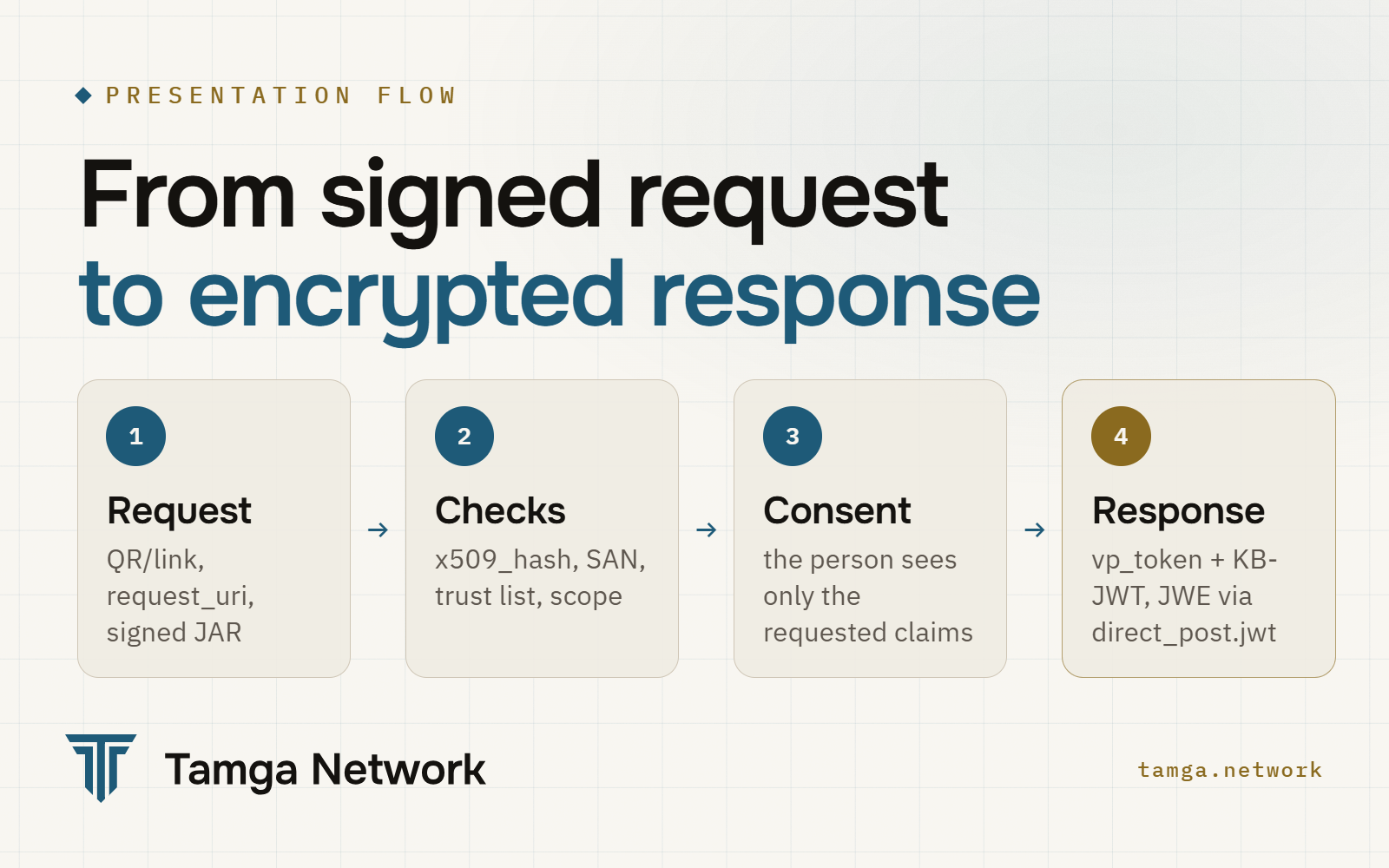
OpenID4VP (OpenID for Verifiable Presentations) 1.0 is how a verifier asks a wallet for credentials and gets back a signed, holder-bound presentation. In Tamga the verifier sends a signed request object that identifies it by the hash of its certificate (x509_hash), states what it wants with a DCQL query, and supplies a one-time encryption key; the wallet answers with an encrypted vp_token posted to the verifier (direct_post.jwt). The verifier then runs a fixed pipeline of format, schema, trust, revocation and policy checks and reaches one of three outcomes.
OpenID4VP 1.0 became Final on 9 July 2025, HAIP 1.0 on 24 December 2025. Tamga's profile is SPEC-PROTO-0002. Presentation Exchange (presentation_definition) from the earlier drafts is not supported: a request that carries it is rejected.
How does the request reach the wallet?
On a different device the verifier shows a QR code; on the same phone it opens a link. Either way the payload is small, because the request object itself is fetched by reference (JAR with request_uri, as HAIP requires):
openid4vp://?client_id=x509_hash%3AUvo3HtuIxuhC92rShpgqcT3YXwrqRxWEviRiA0OZszk
            &request_uri=https%3A%2F%2Fverifier.example.org%2Frequest%2F7Kc2
The wallet fetches request_uri and receives a JWT with typ: oauth-authz-req+jwt, alg: ES256 and the verifier's certificate chain in x5c:
{
  "aud": "https://self-issued.me/v2",
  "iat": 1791446400,
  "exp": 1791446700,
  "client_id": "x509_hash:Uvo3HtuIxuhC92rShpgqcT3YXwrqRxWEviRiA0OZszk",
  "response_type": "vp_token",
  "response_mode": "direct_post.jwt",
  "response_uri": "https://verifier.example.org/vp/response",
  "nonce": "n-0S6_WzA2Mj",
  "state": "af0ifjsldkj",
  "dcql_query": { "credentials": ["… see below …"] },
  "client_metadata": {
    "jwks": { "keys": [{ "kty": "EC", "crv": "P-256", "use": "enc", "alg": "ECDH-ES", "kid": "r1", "x": "…", "y": "…" }] },
    "encrypted_response_enc_values_supported": ["A128GCM", "A256GCM"],
    "vp_formats_supported": {
      "dc+sd-jwt": { "sd-jwt_alg_values": ["ES256"], "kb-jwt_alg_values": ["ES256"] },
      "mso_mdoc": { "issuerauth_alg_values": [-7], "deviceauth_alg_values": [-7] }
    }
  }
}
The encryption key in client_metadata.jwks is ephemeral, created for this request only, as HAIP requires. nonce has at least 128 bits of entropy and is accepted once. HAIP requires verifiers to list both A128GCM and A256GCM; a wallet that supports both should pick A256GCM.
What is x509_hash, and what does the wallet check?
The x509_hash client identifier is the base64url SHA-256 of the DER-encoded leaf certificate that signed the request (OpenID4VP 1.0 §5.9.3). HAIP makes it the one prefix a verifier must use, and a wallet must accept, for signed requests; why Tamga changed its design for it is in HAIP and Token Status List. You can compute it yourself:
openssl x509 -in verifier-leaf.pem -outform DER \
  | openssl dgst -sha256 -binary \
  | basenc --base64url | tr -d '=' \
  | sed 's/^/x509_hash:/'
Before it shows anything to the person, a wallet following Tamga's rules (the reference library is @tamga-network/wallet-core):
- verifies the request signature and the
x5cchain, and checks that the hash inclient_idmatches the leaf certificate; - checks that the domain of
response_uriis one of the certificate's SAN names, which keeps the security property of the olderx509_san_dnsprefix; - checks
exp(required, not passed),iat(not more than 60 seconds in the future) andaud; - looks the fingerprint up in the signed trust list. Tamga's relying party records carry the same value as
client_id, plus a permanentdns_namebecause the hash changes whenever the certificate is renewed; - compares every requested claim with the verifier's registered scope.
An unlisted verifier gets a warning screen that interrupts the flow. A listed verifier asking for a claim outside its scope gets an over-asking warning, with the out-of-scope fields marked and the share button delayed by three seconds. Neither case is blocked outright: the wallet is the person's agent, not their gatekeeper. Requests with the redirect_uri prefix (unsigned) are rejected, and so are x509_san_dns requests, following ADR-0034.
How do you write a DCQL query?
DCQL (Digital Credentials Query Language) lists the credentials a verifier wants and, for each, the claims. A student discount needs one claim:
{
  "credentials": [{
    "id": "student",
    "format": "dc+sd-jwt",
    "meta": { "vct_values": ["urn:tamga:edu:StudentCredential:1"] },
    "claims": [{ "path": ["is_enrolled"], "values": [true] }]
  }]
}
meta.vct_values names the type; Tamga refuses a dc+sd-jwt query without it. values turns a claim into a condition: the credential matches only if is_enrolled is true. The wallet discloses is_enrolled and nothing else.
A job application can accept a diploma or a current student certificate, and can ask for an optional claim:
{
  "credentials": [
    {
      "id": "diploma",
      "format": "dc+sd-jwt",
      "meta": { "vct_values": ["urn:tamga:edu:DiplomaCredential:1"] },
      "claims": [
        { "id": "g", "path": ["is_graduate"], "values": [true] },
        { "id": "q", "path": ["qualification_title"] },
        { "id": "t", "path": ["thesis_title"] }
      ],
      "claim_sets": [["g", "q", "t"], ["g", "q"]]
    },
    {
      "id": "student",
      "format": "dc+sd-jwt",
      "meta": { "vct_values": ["urn:tamga:edu:StudentCredential:1"] },
      "claims": [{ "path": ["is_enrolled"], "values": [true] }]
    }
  ],
  "credential_sets": [
    { "options": [["diploma"], ["student"]], "required": true }
  ]
}
How @tamga-network/wallet-core reads this, following OpenID4VP §6.4:
- In a required set it proposes the first option it can satisfy, in the verifier's order; the person may choose another satisfiable option. Only the chosen option is sent.
- An optional set (
required: false) is off by default and shared only if the person turns it on. - With
claim_sets, only the first combination the credential can satisfy is disclosed. Here a diploma with a thesis title sends three claims and one without sends two. - A credential is never sent with a requested claim missing. If
thesis_titlewere in a plainclaimslist, a diploma without a thesis would not match at all; that is whatclaim_setsis for. - A request may contain at most three credentials and two
credential_setsentries, so the consent screen stays understandable.
For mdoc the path is [namespace, element] and the type goes in meta.doctype_value (ISO mdoc deep dive). HAIP also requires support for trusted_authorities with type aki, which restricts a credential query to issuers whose chain contains a given Authority Key Identifier. Tamga's verifier and wallet both implement it.
What does the wallet send back?
The vp_token is a map from each DCQL id to an array of presentations:
{
  "vp_token": {
    "student": ["eyJhbGciOiJFUzI1NiIsInR5cCI6ImRjK3NkLWp3dCJ9…~WyJ…~eyJhbGciOiJFUzI1NiIsInR5cCI6ImtiK2p3dCJ9…"]
  },
  "state": "af0ifjsldkj"
}
Each SD-JWT VC presentation ends with a KB-JWT whose aud is the full client identifier (x509_hash:Uvo3…), whose nonce is the request's nonce, and whose sd_hash covers exactly the presented disclosures (SD-JWT VC deep dive). For mdoc the value is a base64url DeviceResponse whose device signature covers the OpenID4VP handover.
With direct_post.jwt the whole object is encrypted as a JWE to the verifier's ephemeral key (alg: ECDH-ES on P-256, enc: A256GCM or A128GCM) and posted as a form field:
POST /vp/response HTTP/1.1
Host: verifier.example.org
Content-Type: application/x-www-form-urlencoded

response=eyJhbGciOiJFQ0RILUVTIiwiZW5jIjoiQTI1NkdDTSIsImtpZCI6InIxIiwiZXBrIjp7…

HTTP/1.1 200 OK
Content-Type: application/json

{ "redirect_uri": "https://verifier.example.org/p/9f3c?st=…" }
Why encrypt when TLS is already there? A presentation carries personal data, and between the TLS endpoint and the application sit reverse proxies, firewalls and logs that can see request bodies. With JWE only the holder of the ephemeral key can read it. Tamga uses no unencrypted response mode.
If the person declines, the wallet returns access_denied with no reason. "I don't have this credential" and "I chose not to share it" must look the same, or a verifier could map what a person holds by sending different queries.
How does the verifier reach a verdict?
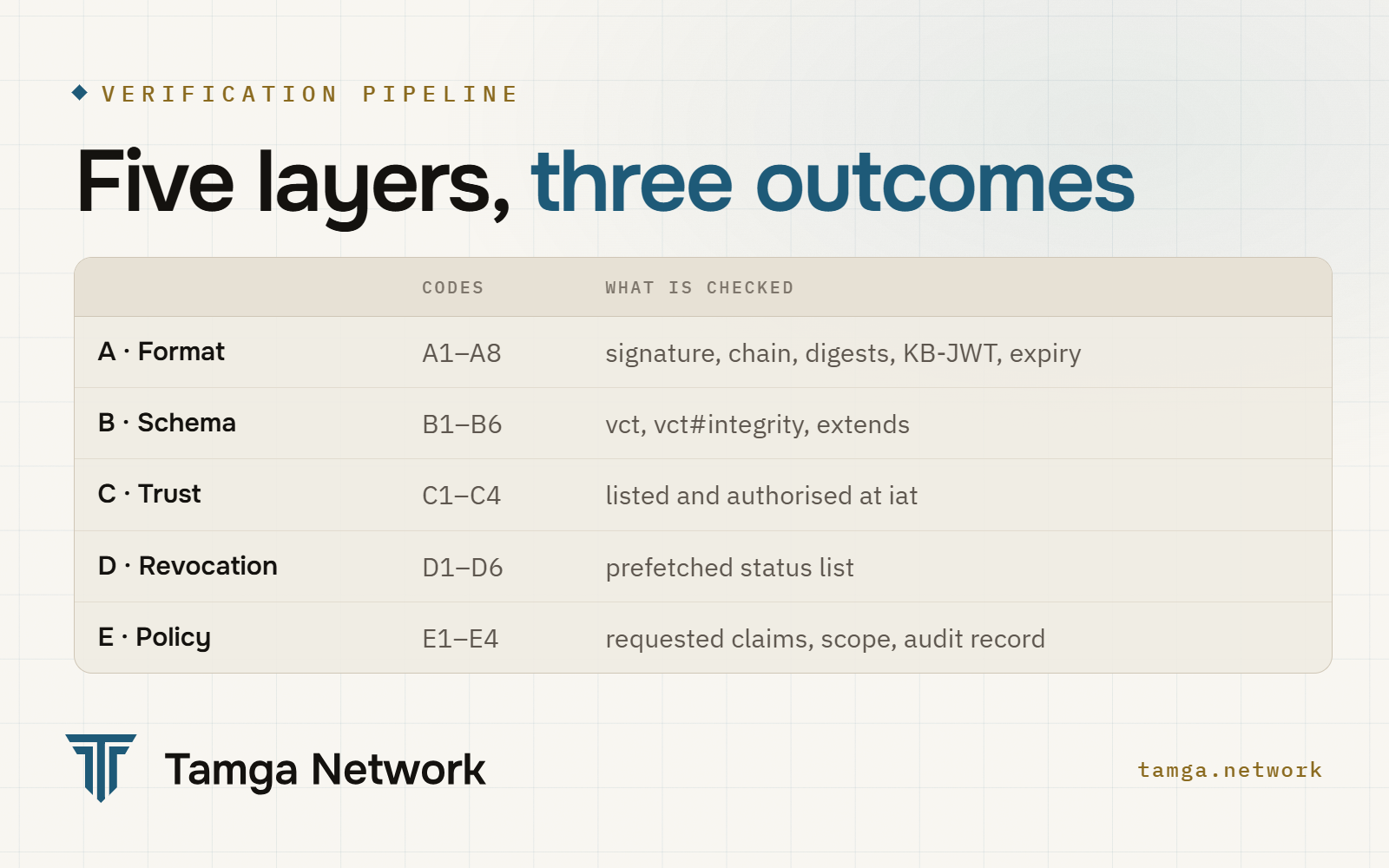
Tamga's verifier runs the steps in a fixed order and stops at the first failure, returning its permanent code as failed_step:
| Layer | Codes | What is checked |
|---|---|---|
| A, format | A1–A8 | issuer signature and chain, issuer identity from the leaf certificate, disclosure digests, KB-JWT (aud, nonce, iat, sd_hash), expiry |
| B, schema | B1–B6 | vct resolved, vct#integrity matches the catalogue, extends chain |
| C, trust | C1–C4 | issuer listed and authorised for this type at the credential's iat |
| D, revocation | D1–D6 | status list from the prefetch cache, signature, freshness, anchor, the bits at idx |
| E, policy | E1–E4 | assurance threshold, every requested claim disclosed, no scope overrun, audit record |
The outcome is ACCEPTED, REJECTED or INDETERMINATE. The third means infrastructure could not be reached (for example a stale status list) and says nothing against the credential; it must be shown differently from a rejection. The result object lists disclosed claim names only, never values, because it goes into the audit log. The full registry is in the verification pipeline.
Same-device or cross-device?
| Same device | Cross device | |
|---|---|---|
| How it starts | link or button on the phone's own browser | QR code on another screen |
| After the response | verifier returns redirect_uri, the wallet follows it | the page on the other screen gets the result from its own back end |
| Phishing resistance | the redirect returns to the session that started the request | weaker: a QR code can be relayed to someone else |
HAIP requires both sides to support the same-device flow and recommends it unless the verifier doesn't rely on session binding. In that flow the verifier must reject a presentation if the redirect never comes back or arrives in a different session. Tamga's hosted verifier returns a redirect_uri after every response, and wallets on the network follow it. How a site wires this up without writing the protocol itself is in Add "verify with Tamga" to your website or app.
What about the browser's Digital Credentials API?
With the W3C Digital Credentials API the browser itself carries the request to the wallet and the response back, using response_mode: dc_api.jwt. The audience of the presentation is then the page's origin, written as origin:https://verifier.example.org, and the browser itself supplies it: a phishing site can't claim another site's origin. A wallet must never accept origin: as a client identifier inside a request. Tamga still recommends a signed request with x509_hash in this flow too, because origin binding solves phishing while x509_hash is what makes the registry lookup and over-asking check possible.
Status today: QR and link presentation are live. The Tamga verifier is ready for the Digital Credentials API, and the wallet connection to it is not there yet.
Frequently asked questions
Why not use x509_san_dns like many earlier deployments?
HAIP 1.0 requires x509_hash for signed requests, and a wallet following HAIP must accept it. Tamga keeps the useful part of x509_san_dns: the response address must be on a domain listed in the signing certificate.
Does the verifier learn which claims I refused?
It learns which claims arrived. If a required set can't be satisfied or the person declines, the wallet returns access_denied without saying why.
Can I still ask for several schema versions?
Yes. Put every accepted version in vct_values, for example urn:tamga:edu:DiplomaCredential:1 and :2. Tamga recommends listing at least two once a second version exists, so earlier holders are not locked out.
Is transaction_data supported?
Not yet. Binding a presentation to a specific transaction is planned for finance and authorisation scenarios; education scenarios don't need it.
Sources
- OpenID for Verifiable Presentations 1.0, Final, 9 July 2025
- OpenID4VC High Assurance Interoperability Profile 1.0, Final, 24 December 2025
- W3C Digital Credentials API
- OpenID4VP profile (SPEC-PROTO-0002), Tamga Network docs
- Verification pipeline and API (SPEC-API-0001), Tamga Network docs
- ADR-0034: HAIP 1.0 conformance, Tamga Network docs
- Presentation, Tamga Network docs
- Verifying on a server, Tamga Network docs
Related
- Post · NetworkAdd "verify with Tamga" to your website or appTwo ways to check Tamga credentials on your site or app: the hosted verifier with a page kit, or your own server with @tamga-network/verifier.
- Post · StandardsSD-JWT VC deep dive: signing, disclosures, KB-JWTHow an SD-JWT VC is built and checked byte by byte - salted digests, _sd, cnf, the KB-JWT and sd_hash, vct#integrity and status - with Tamga's profile.
- Post · StandardsISO mdoc deep dive: CBOR, COSE, MSO and engagementHow an ISO/IEC 18013-5 mdoc is built and verified - CBOR and COSE, the MSO and value digests, device authentication, session transcripts, QR and BLE.
- Post · StandardsHAIP and Token Status List: high assurance without trackingWhat HAIP 1.0 fixes and how Tamga applies it, and how Token Status List revokes credentials without telling the issuer where they are used.
- Post · StandardsOpenID4VCI deep dive: offers, DPoP, proofs, batchesOpenID4VCI 1.0 issuance in Tamga: offers and tx_code, PAR and PKCE, DPoP, the nonce endpoint, key proofs, wallet attestation, batches of 10.
Build on the network
Learn the concepts from scratch, or see how an institution, verifier, wallet or state joins.