OpenID4VCI deep dive: offers, DPoP, proofs, batches
OpenID4VCI 1.0 issuance in Tamga: offers and tx_code, PAR and PKCE, DPoP, the nonce endpoint, key proofs, wallet attestation, batches of 10.
Tamga Network 9 min read
OpenID4VCI (OpenID for Verifiable Credential Issuance) 1.0 is the OAuth-based protocol a wallet uses to obtain a credential from an issuer. The wallet gets an access token at the token endpoint, a fresh c_nonce from the nonce endpoint, and sends key proofs to the credential endpoint, which returns one credential per proven key. Tamga follows the HAIP 1.0 profile on top of it: DPoP-bound tokens, PAR and PKCE in the authorization code flow, wallet attestation at the token endpoint, key attestations, and a batch of 10 copies bound to 10 different keys.
OpenID4VCI 1.0 became Final on 16 September 2025. Two changes from the drafts still trip up code written against them: c_nonce now comes from the nonce endpoint, not the token response, and key proofs travel in proofs (an object of arrays), not proof. Tamga's profile is SPEC-PROTO-0001.
What does the wallet read before it starts?
Every Tamga institution is a path under the hosted issuer, so its metadata uses the path-insertion form of the well-known URL:
GET /.well-known/openid-credential-issuer/example-university HTTP/1.1
Host: issuer.tamga.network
Accept: application/jwt
With Accept: application/jwt the issuer returns signed metadata (typ openidvci-issuer-metadata+jwt, signed with the institution's credential signing certificate in x5c). The wallet compares the signer's fingerprint with the institution's entry in the trust list; if they don't match, the metadata is not used. A plain request returns JSON:
{
  "credential_issuer": "https://issuer.tamga.network/example-university",
  "authorization_servers": ["https://issuer.tamga.network/example-university"],
  "credential_endpoint": "https://issuer.tamga.network/example-university/credential",
  "nonce_endpoint": "https://issuer.tamga.network/example-university/nonce",
  "batch_credential_issuance": { "batch_size": 10 },
  "credential_configurations_supported": {
    "urn:tamga:edu:DiplomaCredential:1": {
      "format": "dc+sd-jwt",
      "scope": "urn:tamga:edu:DiplomaCredential:1",
      "vct": "urn:tamga:edu:DiplomaCredential:1",
      "cryptographic_binding_methods_supported": ["jwk"],
      "credential_signing_alg_values_supported": ["ES256"],
      "proof_types_supported": {
        "jwt": {
          "proof_signing_alg_values_supported": ["ES256"],
          "key_attestations_required": { "key_storage": ["iso_18045_moderate", "iso_18045_high"] }
        }
      },
      "credential_metadata": {
        "credential_reuse_policy": {
          "id": "arf_annex_ii",
          "options": [{
            "details": ["per-relying-party", "once_only"],
            "batch_size": 10,
            "reissue_trigger_unused": 2,
            "reissue_trigger_lifetime_left": 604800
          }]
        }
      }
    }
  }
}
Points worth noticing. Each configuration declares a scope, because HAIP requires one for every configuration and the wallet uses it in the authorization request; Tamga uses the vct URN as both configuration id and scope. nonce_endpoint is present because the credentials are key-bound. key_attestations_required lists the key storage levels the institution accepts. The reuse policy tells the wallet to use a separate copy per verifier and to fetch a new batch when two copies remain or seven days before expiry.
The authorization server metadata (RFC 8414) at /.well-known/oauth-authorization-server/example-university adds token_endpoint, dpop_signing_alg_values_supported: ["ES256"], token_endpoint_auth_methods_supported including attest_jwt_client_auth, and, where wallet-initiated issuance is enabled, pushed_authorization_request_endpoint, require_pushed_authorization_requests: true and code_challenge_methods_supported: ["S256"].
How does an issuer-initiated offer work?
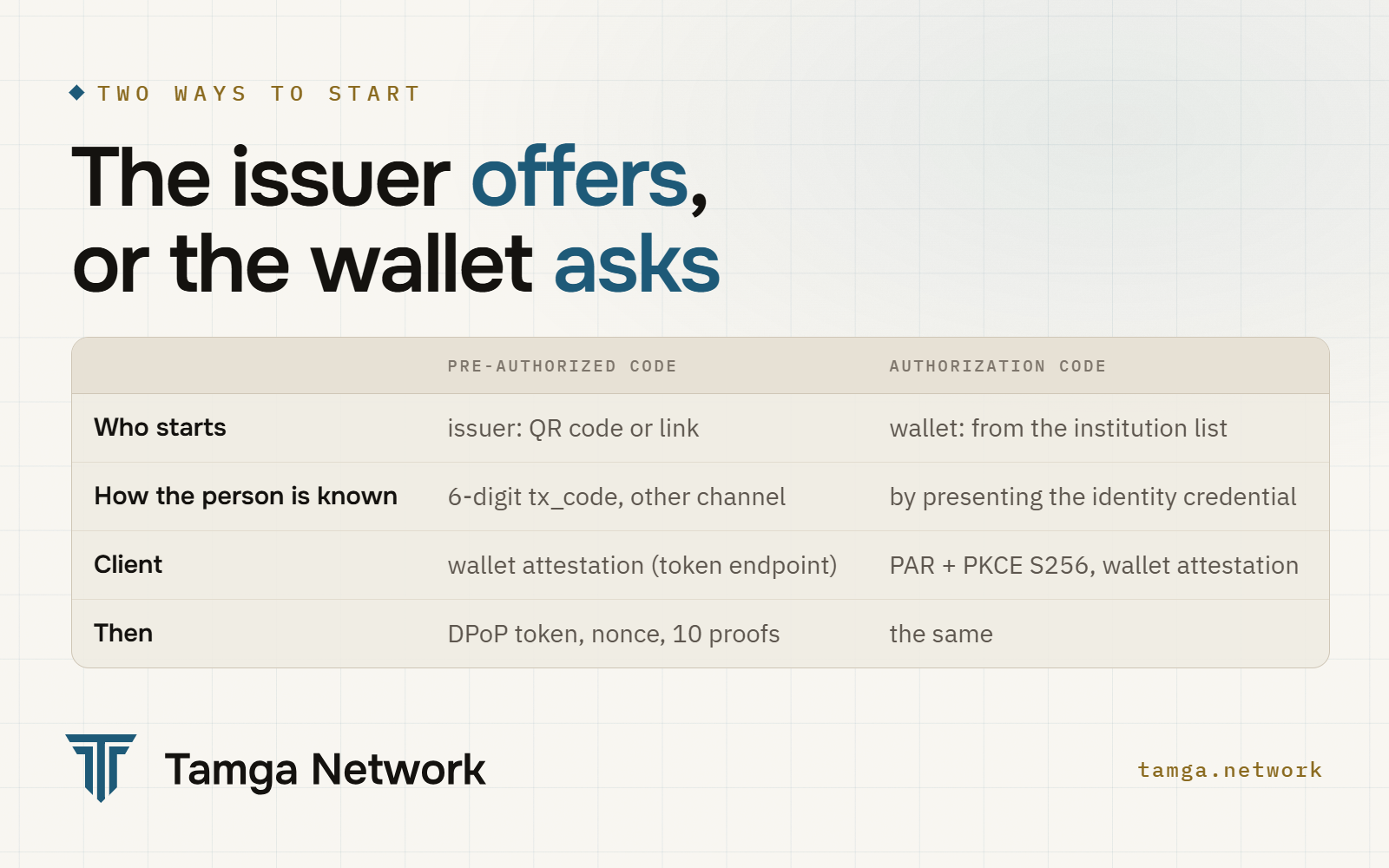
The institution creates a credential offer and shows it as a QR code or a link. To keep the QR small, Tamga sends only credential_offer_uri; the wallet fetches the offer object from it. The URI is single-use and expires after five minutes; a second fetch returns 404.
{
  "credential_issuer": "https://issuer.tamga.network/example-university",
  "credential_configuration_ids": ["urn:tamga:edu:DiplomaCredential:1"],
  "grants": {
    "urn:ietf:params:oauth:grant-type:pre-authorized_code": {
      "pre-authorized_code": "oaKazRN8I0IbtZ0C7JuMn5",
      "tx_code": { "input_mode": "numeric", "length": 6 }
    }
  }
}
The tx_code is the second factor against someone who photographs the QR code over the person's shoulder. In Tamga it can't be skipped in the pre-authorized flow, it is six digits, three wrong attempts void the offer, and it never travels in the same channel as the offer:
| Offer class | Where it appears | Lifetime | How the person proves it's them |
|---|---|---|---|
| on-screen | portal screen, person logged in | 5 min, single use | tx_code shown in the logged-in session |
| out-of-band | QR or link by e-mail or SMS | up to 72 h, single use | tx_code through the other channel, to an address from the institution's records |
| identity-bound | link through the institution's own channel | 7 days, single use | presenting the identity credential (authorization code grant, issuer_state) |
What does the token request look like, and why DPoP?
POST /example-university/token HTTP/1.1
Host: issuer.tamga.network
Content-Type: application/x-www-form-urlencoded
DPoP: eyJ0eXAiOiJkcG9wK2p3dCIsImFsZyI6IkVTMjU2IiwiandrIjp7…fX0…
OAuth-Client-Attestation: eyJ0eXAiOiJvYXV0aC1jbGllbnQtYXR0ZXN0YXRpb24rand0Ii…
OAuth-Client-Attestation-PoP: eyJ0eXAiOiJvYXV0aC1jbGllbnQtYXR0ZXN0YXRpb24tcG9wK2p3dCJ9…

grant_type=urn:ietf:params:oauth:grant-type:pre-authorized_code
&pre-authorized_code=oaKazRN8I0IbtZ0C7JuMn5
&tx_code=493812{ "access_token": "eyJ0eXAiOiJhdCtqd3QiLCJhbGciOiJFUzI1NiJ9…", "token_type": "DPoP", "expires_in": 300 }DPoP (RFC 9449) binds the access token to a key. For each issuance flow the wallet creates an ephemeral P-256 key and signs a dpop+jwt proof carrying jwk, jti, htm, htu and iat. The issuer binds the token to the key's thumbprint, so a stolen token is useless without the key. Requests to the credential endpoint carry Authorization: DPoP <token> plus a new proof with ath, the SHA-256 of the token. If a server answers use_dpop_nonce with a DPoP-Nonce header, the wallet retries once with that nonce, as HAIP asks wallets to be ready for. Tamga's access tokens live five minutes.
The two OAuth-Client-Attestation headers are wallet attestation, the OAuth attestation-based client authentication that HAIP uses. The first is a JWT signed by the wallet provider, with the provider's certificate in x5c; the second is a proof of possession signed with the key in the attestation's cnf, with aud set to the issuer. The issuer checks that the signing certificate belongs to a wallet provider listed in the trust list, and refuses the token (invalid_client) if not. Under HAIP the attestation's sub must be the same for every installation of a wallet product, so it carries no per-phone value; Tamga Wallet, one of the wallets on the network, uses its solution identifier. The short-lived Wallet Instance Attestation (under 24 hours, a fresh key and a fresh revocation entry for each operation) also carries client_status, which the issuer checks against the wallet provider's status list. Why an institution trusts these attestations at all is in How do you trust a wallet?
How does the wallet-initiated flow use PAR and PKCE?
When the person picks an institution from the in-app list (read from the trust list, not from a separate directory server), the wallet starts the authorization code flow:
POST /example-university/par HTTP/1.1
Host: issuer.tamga.network
Content-Type: application/x-www-form-urlencoded
OAuth-Client-Attestation: eyJ…
OAuth-Client-Attestation-PoP: eyJ…

client_id=example-wallet-solution
&response_type=code
&scope=urn%3Atamga%3Aedu%3ADiplomaCredential%3A1
&redirect_uri=…
&code_challenge=E9Melhoa2OwvFrEMTJguCHaoeK1t8URWbuGJSstw-cM
&code_challenge_method=S256
&state=af0ifjsldkj
PAR (RFC 9126) moves the authorization parameters to a back-channel request, and PKCE with S256 (RFC 7636) binds the code to the wallet that started the flow; HAIP requires both through FAPI 2.0. client_id is the wallet attestation's sub. redirect_uri is fixed in the PAR and must match a registered address. For an identity-bound offer the wallet also sends issuer_state.
At /authorize the Tamga issuer does something specific to the network: instead of a login page, it returns a signed OpenID4VP request for the person's identity credential. The wallet runs the normal presentation flow, the issuer verifies the presentation through the full pipeline and matches the person against the institution's own records, and on success redirects with a single-use code valid for at most 60 seconds. The token request then carries grant_type=authorization_code, the code, the code_verifier, the same redirect_uri and the same wallet attestation.
How are key proofs and the batch of 10 sent?
First the wallet asks for a nonce. The endpoint needs no token and responds with Cache-Control: no-store:
POST /example-university/nonce HTTP/1.1
Host: issuer.tamga.network

HTTP/1.1 200 OK
Cache-Control: no-store

{ "c_nonce": "wKI4LT-mMoScTmxmQaMbtcMbtcpaSl" }
Each c_nonce is consumed once, atomically: a "check, then delete" race would let one proof be used twice. Then the wallet generates the device keys in secure hardware and sends the credential request:
POST /example-university/credential HTTP/1.1
Host: issuer.tamga.network
Authorization: DPoP eyJ0eXAiOiJhdCtqd3Qi…
DPoP: eyJ0eXAiOiJkcG9wK2p3dCIs…
Content-Type: application/json

{
  "credential_configuration_id": "urn:tamga:edu:DiplomaCredential:1",
  "proofs": {
    "jwt": [
      "<openid4vci-proof+jwt signed with key 1>",
      "<… key 2 …>",
      "…",
      "<… key 10 …>"
    ]
  }
}
Each proof has typ: openid4vci-proof+jwt, alg: ES256 and the public key in its jwk header, and its payload holds aud (the credential issuer identifier), iat and nonce. The issuer checks every proof, checks that the ten keys are all different, and issues ten credentials, putting each proof's key into that copy's cnf:
{
  "credentials": [
    { "credential": "eyJhbGciOiJFUzI1NiIsInR5cCI6ImRjK3NkLWp3dCJ9…~WyJ…~WyJ…~" },
    "… nine more …"
  ]
}
Each string ends with an empty ~: there is no KB-JWT until the wallet presents it (SD-JWT VC deep dive). For the identity credential, each object also carries an mso_mdoc bound to the same key (ISO mdoc deep dive).
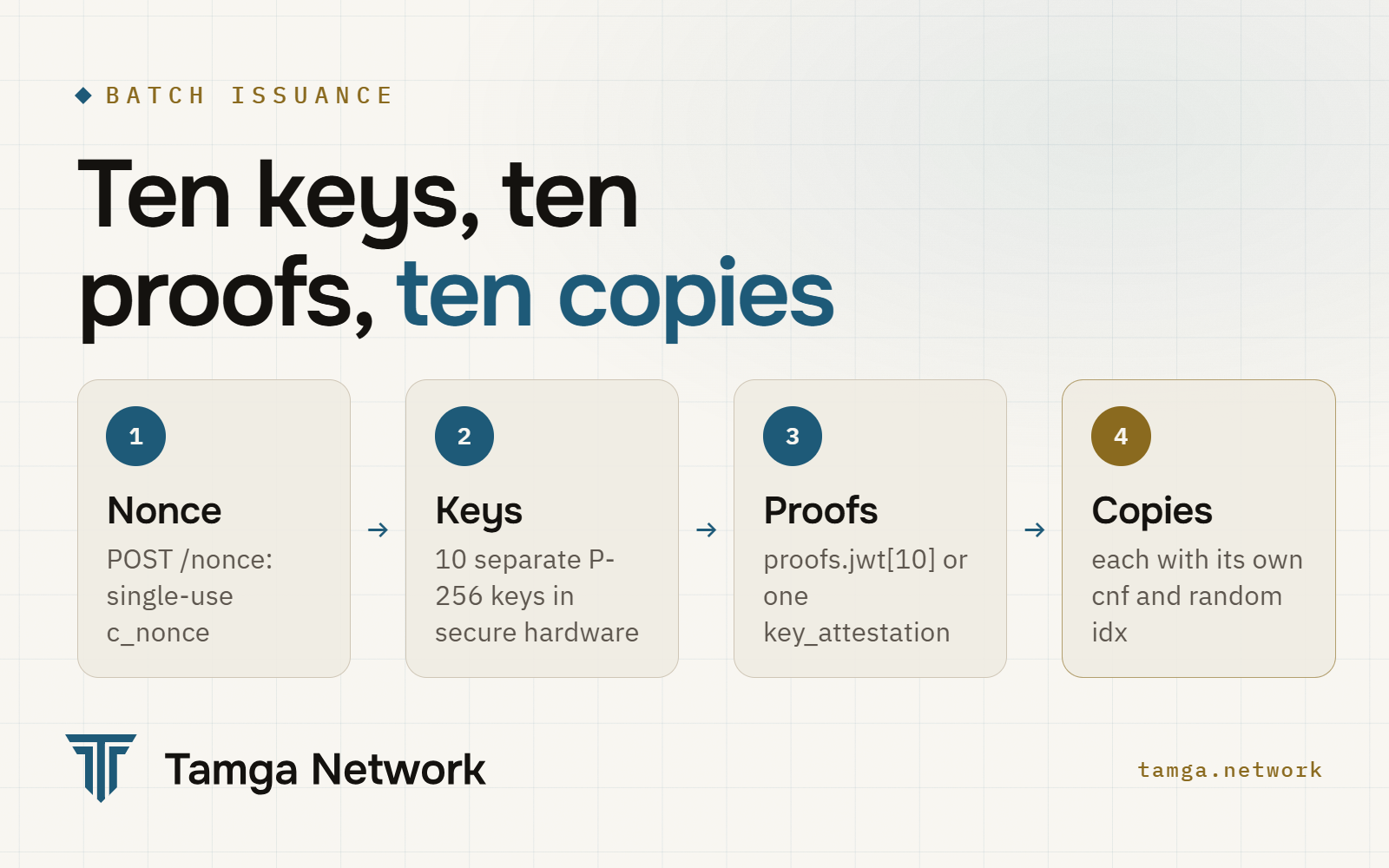
Why ten different keys? If every copy carried the same cnf, two verifiers comparing notes could link the copies, and the batch would protect nothing. Each copy also gets its own random status list index, so copies can't be linked through idx either. When a credential is revoked, the issuer sets all of its copies' indices together; the mapping between copies and indices stays in the issuer's own database. This applies to every credential type, diplomas included.
With a key attestation the batch can be requested with a single proof instead. The proof's header carries key_attestation, a JWT signed by the wallet provider that lists attested_keys and states their storage level, and the proof is signed with the first attested key. The issuer checks the attestation, its revocation status and the nonce, applies the institution's minimum key storage level, and binds one copy to each attested key. OpenID4VCI 1.0 defines this format in its Appendix D.
Does Tamga use deferred issuance?
The profile describes it for one case, a diploma whose graduation decision is not yet approved, with rules of its own: a transaction_id lives at most 30 days, the polling interval is at least 300 seconds, and the wallet backs off exponentially, because regular polling tells the issuer "this person is still waiting". No Tamga issuer offers it today: the metadata has no deferred_credential_endpoint, so a diploma is offered only once it can be signed. In OpenID4VCI 1.0 Final, a deferred answer is HTTP 202 with transaction_id and interval, and a still-pending deferred request gets HTTP 202 again; implementations built from older drafts expect an issuance_pending error instead.
Which errors should a wallet handle?
| Error | Meaning | Wallet behaviour |
|---|---|---|
invalid_proof | a proof is missing, invalid or has no nonce | get a new c_nonce, retry |
invalid_nonce | the nonce is stale or used | get a new c_nonce, retry |
invalid_credential_request | malformed request | report, don't retry |
unknown_credential_configuration | configuration not offered | refresh metadata |
credential_request_denied | not authorised, or authorisation withdrawn | don't retry |
invalid_client (token) | wallet attestation missing, invalid or revoked | stop |
invalid_token | the access token expired | restart the flow |
Error responses carry no personal data. "No record found for this person" is returned as credential_request_denied; the detail stays in the issuer's own audit log.
Frequently asked questions
Why is the tx_code never in the QR code?
Because the QR code may be seen or photographed by someone else. If the code travelled with it, that person could collect the credential into their own wallet. Splitting them across channels means both must be captured.
Does HAIP require the pre-authorized code flow?
No. HAIP requires the authorization code flow. Tamga supports both: pre-authorized offers for institutions whose portal already knows the person, and the authorization code flow with PAR, PKCE and identity presentation for wallet-initiated requests.
Can the issuer tell which verifier a copy was used with?
No. The issuer doesn't see presentations, and copies don't share a key or a status index, so even colluding verifiers can't link them through the credential.
What happens when the copies run out?
The wallet asks for a new batch when two copies remain, using a single-use, DPoP-bound refresh token. At a verifier it already knows it keeps using that verifier's copy; at a new verifier it asks the person before reusing a copy.
Sources
- OpenID for Verifiable Credential Issuance 1.0, Final, 16 September 2025
- OpenID4VC High Assurance Interoperability Profile 1.0, Final, 24 December 2025
- RFC 9449: OAuth 2.0 Demonstrating Proof of Possession (DPoP), IETF
- RFC 9126: OAuth 2.0 Pushed Authorization Requests, IETF
- OpenID4VCI profile (SPEC-PROTO-0001), Tamga Network docs
- Issuance, Tamga Network docs
- ADR-0025: Wallet instance and key attestations, Tamga Network docs
- Issuing credentials as an institution, Tamga Network docs
@tamga-network/issuer, Tamga Network docs
Related
- Post · PrivacyHow do you trust a wallet? Attestations and hardware keysHow an institution on Tamga Network decides a wallet is safe to issue to: wallet attestations, key attestations, hardware evidence and the trust list.
- Post · StandardsSD-JWT VC deep dive: signing, disclosures, KB-JWTHow an SD-JWT VC is built and checked byte by byte - salted digests, _sd, cnf, the KB-JWT and sd_hash, vct#integrity and status - with Tamga's profile.
- Post · StandardsOpenID4VP and DCQL deep dive: request to verdictHow a verifier requests and checks credentials with OpenID4VP 1.0: x509_hash signed requests, DCQL, encrypted direct_post.jwt, the A–E pipeline.
- Post · StandardsHAIP and Token Status List: high assurance without trackingWhat HAIP 1.0 fixes and how Tamga applies it, and how Token Status List revokes credentials without telling the issuer where they are used.
- Post · NetworkHow an institution joins Tamga NetworkHow an institution joins Tamga Network: try it in the sandbox, apply with registration data and a CSR, get listed, issue the first credential.
Build on the network
Learn the concepts from scratch, or see how an institution, verifier, wallet or state joins.