SD-JWT VC deep dive: signing, disclosures, KB-JWT
How an SD-JWT VC is built and checked byte by byte - salted digests, _sd, cnf, the KB-JWT and sd_hash, vct#integrity and status - with Tamga's profile.
Tamga Network 9 min read
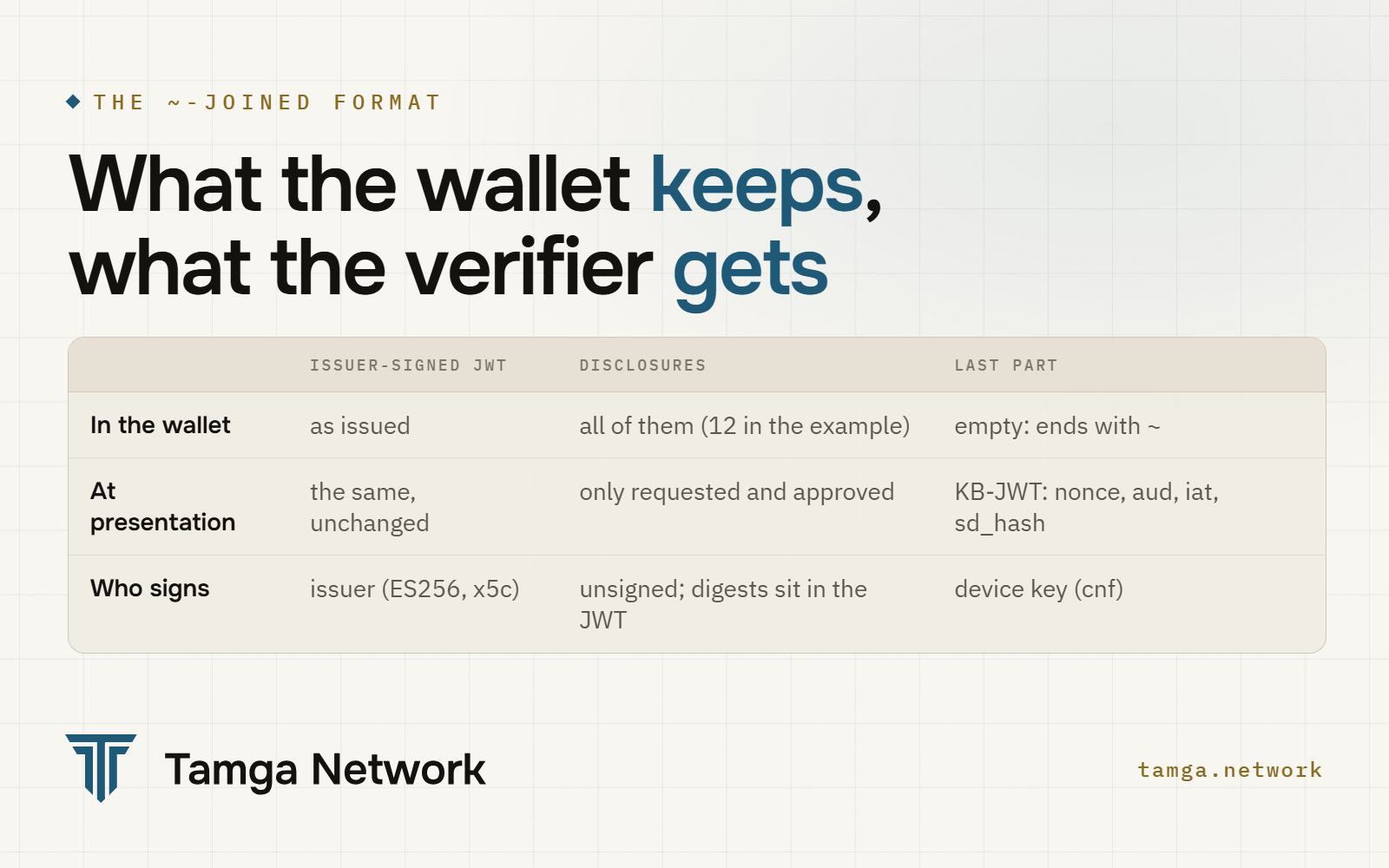
An SD-JWT VC is a JWT signed by the issuer that carries salted SHA-256 digests instead of claim values, plus a list of disclosures (the salted values themselves) sent next to it, joined with ~. The holder reveals a claim by sending its disclosure and hides it by leaving the disclosure out, and a KB-JWT signed with the holder's device key closes each presentation.
Two standards are involved. SD-JWT is the mechanism, published by the IETF as RFC 9901 in November 2025. SD-JWT VC is the credential profile on top of it, draft-ietf-oauth-sd-jwt-vc; version 19 (31 August 2026) is in IESG evaluation. Tamga's byte-level profile is SPEC-CRED-0002.
What does the issuer actually sign?
The issuer-signed JWT has an ordinary JOSE header and a payload in which hideable claims are replaced by digests:
{
  "alg": "ES256",
  "typ": "dc+sd-jwt",
  "x5c": ["MIICCzCCAbCgAwIBAgIC…"]
}
{
  "iss": "https://issuer.tamga.network/example-university",
  "vct": "urn:tamga:edu:DiplomaCredential:1",
  "vct#integrity": "sha256-Vu/H8v+3kpCQBmre8A8It13M6+pUpUqcLc08P57aKKw=",
  "iat": 1790619528,
  "cnf": {
    "jwk": {
      "kty": "EC", "crv": "P-256",
      "x": "hFEM1avAMSadeciYwVO0nJ6aMEM8YDCTigu_GO4tqgM",
      "y": "R-5AIVbUthAPOiJm4-2U8aB1Oppfyjl84HhDZrLqdfU"
    }
  },
  "status": {
    "status_list": { "idx": 48213, "uri": "https://status.tamga.network/3f9a2c" }
  },
  "_sd_alg": "sha-256",
  "_sd": [
    "5O0ow4w1pES5PcWsRp0I7b5-Y6-C1HSLuKtPC2IdFRo",
    "9xI8VcNCjl8OcW6W0n30e_LGJ4lm3ah3SAEVEI4pM38",
    "FJqsIjUpFitVLNSAhwL-3LcB-_4YoIupLGFhC5WhdMs",
    "IpStBdfeq4pqVfpP9xFH2ZM46lojLf7cqcEpDBk9OV4",
    "JtA0TsH7O4ImtZ4Ks60seDP4TGfHvP3hByuCG5fkvX4",
    "kA0R62-bxuHSJj4MRsE0x98cmZRcbiJ_iyYD60jfJwI",
    "…6 more, sorted"
  ]
}
The claims in the clear are the ones a verifier needs before it can read anything else. In Tamga they are marked sd: "never" in the type metadata and can never be hidden:
| Claim | Why it stays visible |
|---|---|
iss | consistency check against the registered issuer |
vct, vct#integrity | type resolution and pinning |
iat | the trust checks are time-bound to it |
cnf | needed to verify the KB-JWT |
status | revocation lookup |
_sd_alg, _sd | the mechanism itself |
exp | when the type has one |
Draft 19 lets an issuer make iat selectively disclosable. Tamga keeps it visible because the verifier asks the trust layer "was this issuer allowed to issue this type at iat?", not "is it allowed today".
The header carries the issuer's certificate chain in x5c, leaf first, without the root. HAIP 1.0 requires x5c-based key resolution, and Tamga makes x5c mandatory. The verifier derives the issuer's identity from the leaf certificate fingerprint, never from iss. If it trusted iss, any institution with a valid certificate under the same root could write another university's URL into iss and sign with its own key.
typ is dc+sd-jwt. The draft used vc+sd-jwt until November 2024 and changed it to avoid a clash with a W3C media type. Tamga issuers produce only dc+sd-jwt, and the verifier rejects vc+sd-jwt unless a compatibility flag for external credentials is switched on (it is off by default).
How is a disclosure built, and why hash the string?
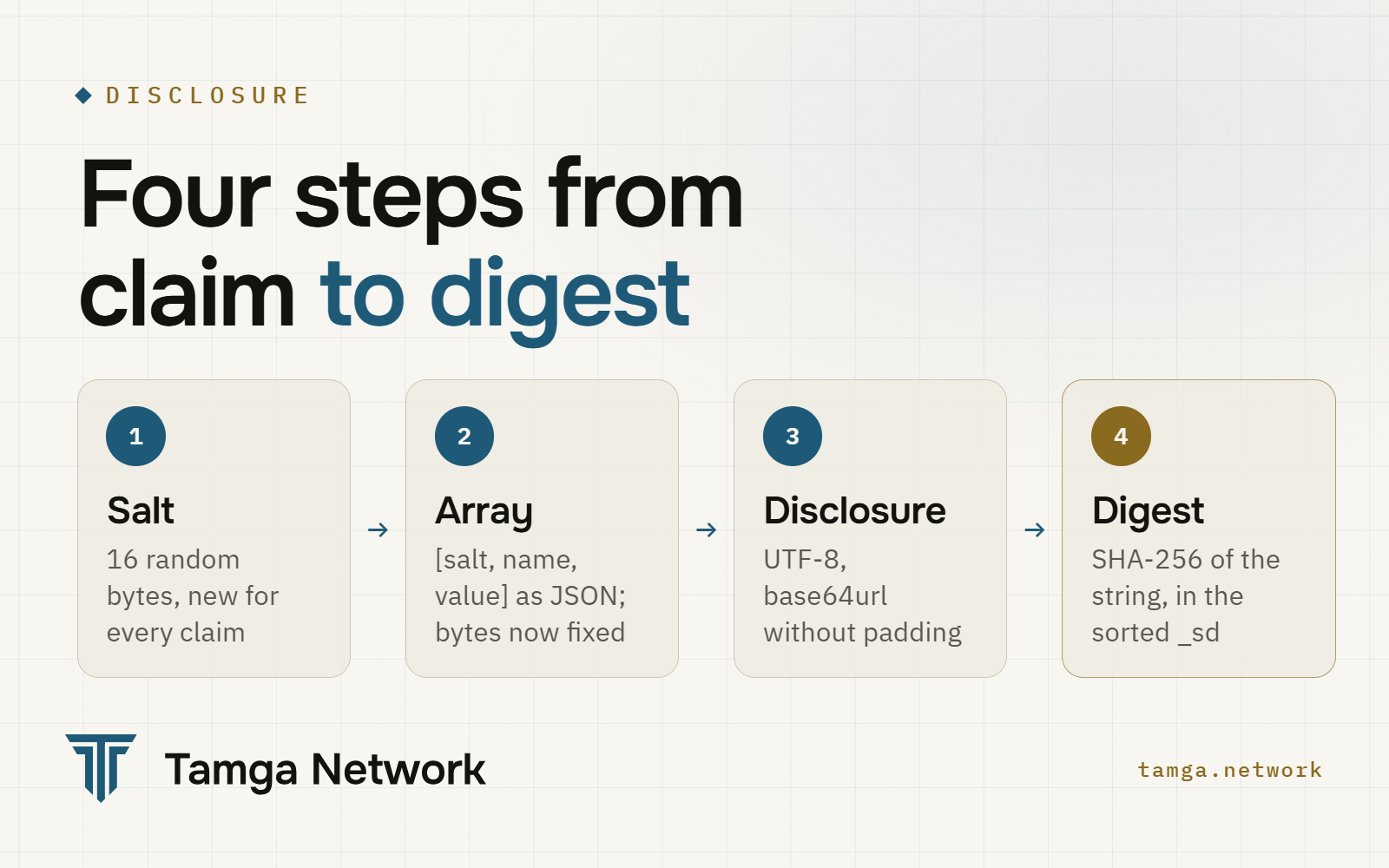
A disclosure is a three-element JSON array [salt, name, value], UTF-8 encoded and then base64url-encoded without padding. The salt is 16 random bytes (128 bits), new for every disclosure. Here are the four disclosures from the vector's presentation:
WyJJY3NEZDFmdmh6bS1mcVpTNDJLb1p3IiwiZXFmX2xldmVsIiw2XQ
  → ["IcsDd1fvhzm-fqZS42KoZw","eqf_level",6]
  → 5O0ow4w1pES5PcWsRp0I7b5-Y6-C1HSLuKtPC2IdFRo

WyJoY0FvdmV4bmpkTFd3aF9sN1hkM1ZBIiwiaXNfZ3JhZHVhdGUiLHRydWVd
  → ["hcAovexnjdLWwh_l7Xd3VA","is_graduate",true]
  → kA0R62-bxuHSJj4MRsE0x98cmZRcbiJ_iyYD60jfJwI

WyJSc3ZSUXY2cDhGM3NfRXRBSXFQTnpnIiwiZmFtaWx5X25hbWUiLCLDlnJuZWsiXQ
  → ["RsvRQv6p8F3s_EtAIqPNzg","family_name","Örnek"]
  → JtA0TsH7O4ImtZ4Ks60seDP4TGfHvP3hByuCG5fkvX4

WyJjazFtMktWejdVWEg2cTlMNEJad1BRIiwiZ2l2ZW5fbmFtZSIsIlZla3TDtnIiXQ
  → ["ck1m2KVz7UXH6q9L4BZwPQ","given_name","Vektör"]
  → sHl3d9xOXRVt7kU78VQvmAjq4kZzrWjyyJV1sBfRA1M
The digest is base64url(SHA-256(ASCII bytes of the disclosure string)). Every one of the four digests above appears in the payload's _sd array.
The single most common bug in SD-JWT code is to decode the disclosure, re-serialise the array and hash the result. JSON serialisation is not deterministic: a space after a comma, or ö written as ö, gives different bytes and a different digest. Tamga's spec shows this with a disclosure for given_name: "Ayşe", where re-serialising without spaces or escapes turns nM_EESmLJt3b0fzNu1paGyiAfSLs4Npf2yEjUn0upSo into c94D71JDfX8hzanT-ZpRWBn5oNX_RkStfSfkvTmY_kU. The rule for verifiers is simple: hash the string as received, then decode it. Never the other way round.
Why is the _sd array sorted, and why no decoys?
Tamga sorts _sd in ascending byte order. Unsorted, the digests would sit in the order the issuer processed the claims, which usually follows the schema. A verifier could then line up the hidden digests with the schema's field list and tell which fields were withheld.
RFC 9901 also allows decoy digests, fake entries that match no disclosure, to blur how many claims are hidden. Tamga forbids them. The vct is in the clear and the type metadata lists every field, so the count is public anyway. Different decoy counts across issuers would themselves become a fingerprint, and each decoy adds 43 characters to a QR code. The real side channel is a changing disclosure set, so Tamga's wallet rules require wallets on the network to keep the set consistent per verifier and type instead.
Two further profile limits: nested selective disclosure is capped at two levels, and hiding individual array elements is not used yet.
How does holder binding work, and what does the KB-JWT sign?
cnf.jwk is the public half of a P-256 key created in the phone's secure hardware during issuance (the issuer copies it from the wallet's key proof; see the OpenID4VCI deep dive). The private half never leaves the device. In Tamga a credential without cnf is invalid, and so is a presentation without a KB-JWT. The standard leaves key binding optional; HAIP requires a KB-JWT whenever the credential has holder binding, and Tamga binds every credential.
At presentation time the wallet keeps only the disclosures the verifier asked for and the person approved, then appends a KB-JWT:
{ "alg": "ES256", "typ": "kb+jwt" }
{
  "nonce": "conf-nonce-0001",
  "aud": "x509_hash:9OGMDF0OXzjg3FX8kOjh9tUnI7A5VhSc1mweK1ElZ_Q",
  "iat": 1790705928,
  "sd_hash": "-SOR78_i6a2u-_oX-jovk7jVjCrsZYIe35q4lixd8NE"
}
nonce is the verifier's single-use challenge, so a recorded presentation can't be replayed. aud is the verifier's full client identifier, prefix included; over OpenID4VP that is x509_hash: plus the fingerprint of its access certificate (OpenID4VP and DCQL deep dive). iat must be within 300 seconds of the verifier's clock.
sd_hash is what stops a middleman from deleting a disclosure:
sd_hash = base64url( SHA-256( ASCII bytes of
  "<issuer-signed JWT>~<disclosure 1>~<disclosure 2>~…~<disclosure n>~"
))
Only the presented disclosures are included, and the trailing ~ is part of the input. Without sd_hash, someone could drop the grade disclosure from a diploma presentation and both signatures would still verify.
A reminder of scope: a valid KB-JWT proves control of the key bound to the credential. It does not prove which human is holding the phone.
What are vct and vct#integrity for?
vct names the credential type. Tamga uses URNs, urn:tamga:<domain>:<Type>:<major>, so the identifier does not change if a domain name does. The type metadata document lives at an HTTPS address that the public catalogue maps from the URN; draft 19 calls this resolution "from a registry" (§5.3.2). For the diploma, https://schemas.tamga.network/v1/catalogue.json maps urn:tamga:edu:DiplomaCredential:1 to its metadata file and to the content hash sha256-Vu/H8v+3kpCQBmre8A8It13M6+pUpUqcLc08P57aKKw=, the same string as vct#integrity in the vector.
The integrity value uses the W3C Subresource Integrity format: sha256- followed by the base64 SHA-256 of the document's raw bytes. The published file must stay byte-for-byte identical; no proxy may reformat it. The standard makes vct#integrity optional. Tamga makes it mandatory, so a verifier can never be handed a different definition of a type than the one the issuer signed against. The type metadata is also where each claim's sd policy (always, allowed, never) is written, and Tamga issuers hide every claim that is allowed to be hidden.
What does the status claim point to?
status.status_list holds an index (idx) and the URI of a Token Status List. The verifier reads two bits at that index from a signed, compressed list it fetched earlier: 0 valid, 1 revoked, 2 suspended; 3 is unused and treated as revoked. Tamga allocates indices at random, keeps list URIs opaque, and expects verifiers to prefetch lists on a schedule so that the issuer never learns when a credential is checked. Draft 19 requires the referenced status list to be in JWT form. The mechanics and the privacy rules are in HAIP and Token Status List.
In what order should a verifier check an SD-JWT VC?
Tamga gives every verification step a permanent code, and its verifier returns the first failing code as failed_step. The format layer runs first:
| Code | Check |
|---|---|
| A1 | split on ~; the last part must be a KB-JWT, not empty |
| A2 | header: alg = ES256, typ = dc+sd-jwt, x5c present |
| A3 | chain to a listed root, intermediates are CAs, JWT signature valid |
| A3b | issuer identity from the leaf certificate fingerprint, not from iss |
| A3c | leaf certificate not revoked |
| A3d | cnf present |
| A4 | _sd_alg = sha-256 |
| A5 | each disclosure: hash the string, find it in _sd, then decode |
| A6 | KB-JWT: signature with cnf, aud, nonce, iat within ±300 s, sd_hash |
| A7 | exp not passed, nbf reached |
| A8 | no digest claimed twice, no disclosure overwriting a visible claim |
Two of these deserve a second look. A5 rejects any disclosure whose digest is not in _sd, because accepting it would let anyone add claims the issuer never signed. A8 rejects a disclosure named, say, iss or vct, because it would overwrite a visible claim.
After the format layer come schema checks (B1–B6: resolve vct, compare the integrity hash with the catalogue, follow extends), trust checks against the signed trust list (C1–C4: was the issuer listed and authorised for this type at iat), revocation (D1–D6) and the verifier's own policy (E1–E4). The result has three values: accepted, rejected, or indeterminate when infrastructure such as a status list can't be reached. "I can't check right now" is never reported as "invalid". The full registry is in the verification pipeline.
You can run all of this against the same bytes we use: the vector, its five negative cases (no KB-JWT, wrong nonce, iat 301 seconds off, an unmatched disclosure, an expired credential) and the runner are in the conformance folder of the open repository.
What does the Tamga profile change compared with the standard?
| Topic | Standard | Tamga |
|---|---|---|
| Signature | several algorithms | ES256 only |
_sd_alg | several | sha-256, written explicitly |
typ | dc+sd-jwt | dc+sd-jwt; vc+sd-jwt rejected by default |
| Issuer key | iss metadata, x5c or other | x5c mandatory, root not included |
| Key binding | optional | mandatory for every credential |
| Decoy digests | allowed | forbidden |
_sd order | not specified | sorted |
vct#integrity | optional | mandatory |
| Nested disclosure | allowed | at most two levels |
Everything else follows RFC 9901 and draft 19, and a Tamga verifier still verifies disclosures serialised differently from Tamga's own issuer, because it hashes strings, not arrays.
Frequently asked questions
Can I use a generic SD-JWT library to verify Tamga credentials?
Yes, if it hashes disclosure strings as received and lets you enforce key binding. Add Tamga's profile checks on top: ES256 only, x5c chain to a listed root, issuer identity from the leaf certificate, mandatory KB-JWT and vct#integrity. The @tamga-network/sd-jwt and @tamga-network/verifier packages do all of this.
Why is aud the full client identifier and not just a hostname?
Because the client identifier is what the wallet verified. Over OpenID4VP the verifier is identified by x509_hash: plus its certificate fingerprint, and binding the KB-JWT to exactly that value means the presentation is useless to anyone else.
Does hiding a claim change the issuer's signature?
No. Hiding means removing the disclosure from the ~-joined string. The signed JWT is never re-signed or modified.
Why 128-bit salts?
A digest of a low-entropy value such as a birth date could otherwise be found by trying every possible date. A fresh 16-byte salt per disclosure makes that infeasible and also stops the same claim from producing the same digest in two credentials.
Sources
- RFC 9901: Selective Disclosure for JSON Web Tokens, IETF, November 2025
- draft-ietf-oauth-sd-jwt-vc-19: SD-JWT-based Verifiable Digital Credentials, IETF, August 2026
- OpenID4VC High Assurance Interoperability Profile 1.0, Final, 24 December 2025
- SD-JWT VC profile (SPEC-CRED-0002), Tamga Network docs
- Verification pipeline and API (SPEC-API-0001), Tamga Network docs
- Schema catalogue (Type Metadata, vct#integrity), Tamga Network docs
- Conformance vectors and runner, Tamga Network repository
@tamga-network/sd-jwt, Tamga Network docs
Related
- Post · StandardsOpenID4VCI deep dive: offers, DPoP, proofs, batchesOpenID4VCI 1.0 issuance in Tamga: offers and tx_code, PAR and PKCE, DPoP, the nonce endpoint, key proofs, wallet attestation, batches of 10.
- Post · StandardsOpenID4VP and DCQL deep dive: request to verdictHow a verifier requests and checks credentials with OpenID4VP 1.0: x509_hash signed requests, DCQL, encrypted direct_post.jwt, the A–E pipeline.
- Post · StandardsHAIP and Token Status List: high assurance without trackingWhat HAIP 1.0 fixes and how Tamga applies it, and how Token Status List revokes credentials without telling the issuer where they are used.
- Post · StandardsISO mdoc deep dive: CBOR, COSE, MSO and engagementHow an ISO/IEC 18013-5 mdoc is built and verified - CBOR and COSE, the MSO and value digests, device authentication, session transcripts, QR and BLE.
- LearnSelective disclosureEach field of a credential is sealed separately; the person opens only the field asked for, the rest stays closed.
Build on the network
Learn the concepts from scratch, or see how an institution, verifier, wallet or state joins.