ISO mdoc deep dive: CBOR, COSE, MSO and engagement
How an ISO/IEC 18013-5 mdoc is built and verified - CBOR and COSE, the MSO and value digests, device authentication, session transcripts, QR and BLE.
Tamga Network 8 min read
An mdoc is the mobile document format defined in ISO/IEC 18013-5:2021, the standard for mobile driving licences. It is CBOR signed with COSE: the issuer signs a Mobile Security Object (MSO) that lists a digest of every data element and the holder's device key, the holder sends only the elements a reader asked for, and a device signature over a session transcript binds the response to that one session. Tamga issues its identity credential as an mdoc next to its SD-JWT VC.
Why does Tamga issue the identity credential in two formats?
ADR-0013, accepted on 26 September 2026, gives three reasons. The EU's architecture for digital identity wallets requires mdoc for person identification data and treats SD-JWT VC as optional. In-person presentation under ISO 18013-5 carries mdoc. And when the decision was taken, Safari's Digital Credentials API accepted only mdoc, while Chrome accepted both formats.
The rules that follow from that decision:
- SD-JWT VC stays primary. mdoc is a second representation of the same credential, and only for the identity credential (
urn:tamga:id:IdentityAttestation:1). Student certificates, diplomas and tickets stay SD-JWT VC only. - Same fields, same validity, same key. The mdoc
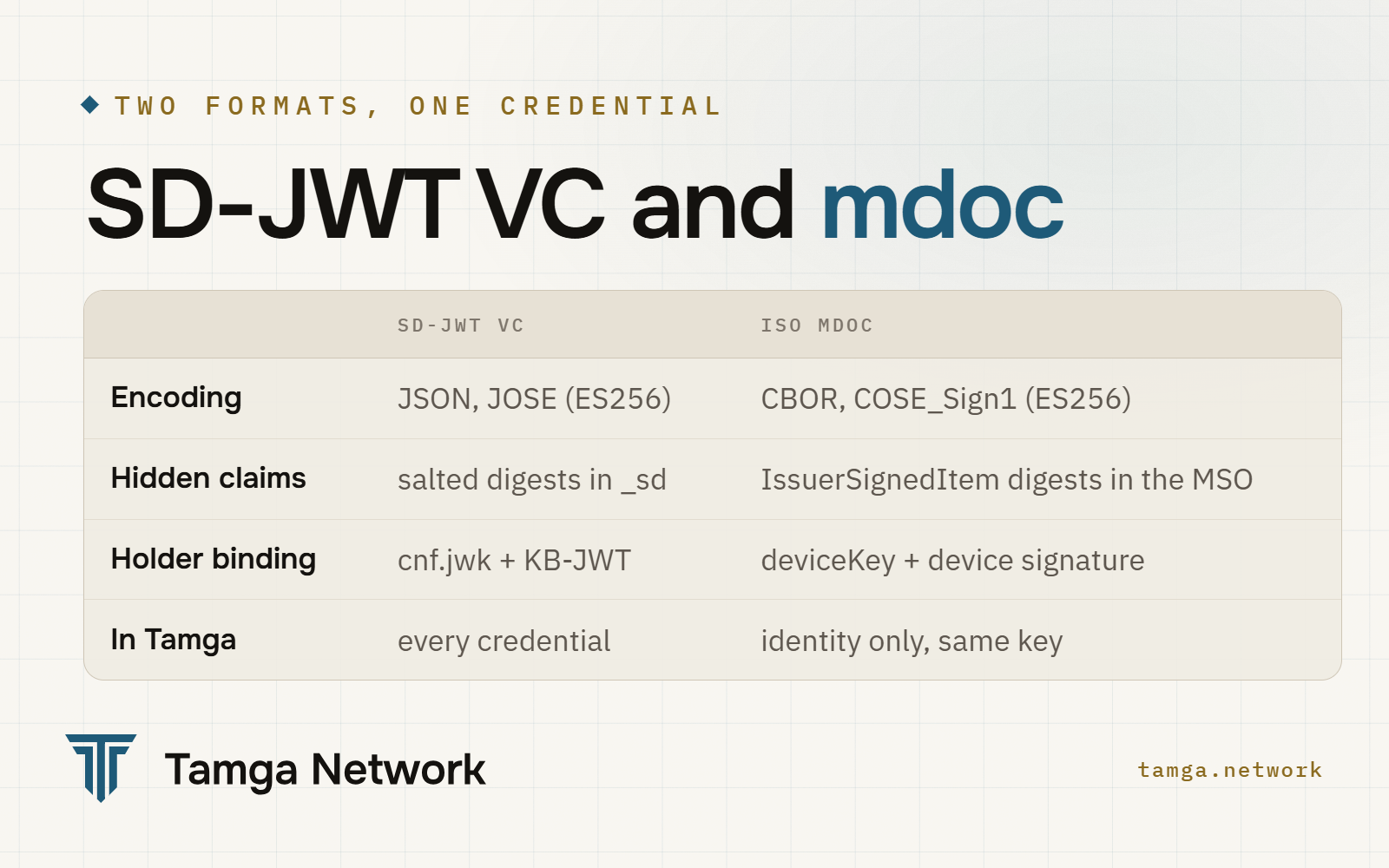
deviceKeyis the SD-JWTcnf.jwk. No second holder key is created. - Separate issuer signatures. JOSE/ES256 for SD-JWT,
COSE_Sign1/ES256 for mdoc, with the same certificate chain resolving to the same trust list entry. - One issuance, one status bit. Each object in the credential response carries the SD-JWT VC and the mdoc (base64url
IssuerSigned), both bound to the same proof key and the same status list index. The wallet does not store the mdoc until it has cross-checked it against the SD-JWT copy: same issuer certificate, same fields,deviceKeyequal tocnf.
How is an mdoc encoded?
Everything is CBOR (RFC 8949), a binary encoding with the same data model as JSON plus byte strings, tags and integer keys. Two tags matter here. Tag 24 means "the following byte string is itself encoded CBOR"; it lets a signer hash exact bytes rather than a re-encoded structure, the same lesson SD-JWT teaches with its disclosure strings (SD-JWT VC deep dive). Tag 0 marks an RFC 3339 date-time string.
Signatures use COSE (RFC 9052), CBOR's counterpart to JOSE. A COSE_Sign1 is a four-element array: protected header, unprotected header, payload and signature. Tamga's issuer signature has {1: -7} (ES256) in the protected header and the certificate chain in x5chain.
ADR-0013 records one interoperability caveat. Tamga encodes deterministic CBOR per RFC 8949 §4.2.1 (bytewise lexicographic key order), while ISO 18013-5:2021 refers to the older length-first ordering of RFC 7049. Because digests are taken over tag-24 bytes as issued, verification does not depend on the ordering rule, but the item is tracked for full interoperability.
What is a data element and how is it hashed?
Each field is an IssuerSignedItem: a map with a digestID, 16 random bytes, the element name and its value, encoded and wrapped in tag 24. Its digest is the SHA-256 of those tagged bytes.
24(<< {
  "digestID": 1192084209,
  "random": h'fe3f2636f3f4a9fa0b315de1f14e8dcd',
  "elementIdentifier": "age_over_18",
  "elementValue": true
} >>)

SHA-256 of the tagged bytes: c2418dcd28b95cc1…
The random value does the job of the SD-JWT salt: without it, the digest of age_over_18: true would be the same in every credential and could be guessed. The digestID links the item to its entry in the MSO. Tamga assigns digestIDs at random within 31 bits instead of counting 0, 1, 2…, so the IDs a holder reveals say nothing about how many elements exist or where they sat.
Elements live in namespaces. Tamga's identity namespace is tamga.id.1, and its element names match the SD-JWT claim names one to one: family_name, given_name, birth_date, nationality, personal_administrative_number, document_type, document_number_hash, issuing_country, document_chip_verified, verification_method and age_over_18. All of them are selectively disclosable. There is no portrait element.
What does the Mobile Security Object contain?
The MSO is the issuer-signed part. It is encoded, wrapped in tag 24 and used as the payload of the issuer's COSE_Sign1 (issuerAuth):
{
  "version": "1.0",
  "digestAlgorithm": "SHA-256",
  "docType": "urn:tamga:id:IdentityAttestation:1",
  "valueDigests": {
    "tamga.id.1": {
      692698667:  h'9852780268ee6d84…',
      1192084209: h'c2418dcd28b95cc1…',
      1688544371: h'195cd811675f41a9…',
      1708359320: h'd67a4825ac901b31…',
      1956174090: h'3dbc0b38db348aef…'
    }
  },
  "deviceKeyInfo": { "deviceKey": { 1: 2, -1: 1, -2: h'…', -3: h'…' } },
  "validityInfo": {
    "signed":     0("2026-10-08T08:00:00Z"),
    "validFrom":  0("2026-10-08T08:00:00Z"),
    "validUntil": 0("2028-10-07T08:00:00Z")
  },
  "status": {
    "status_list": { "idx": 48213, "uri": "https://status.tamga.network/3f9a2c" }
  }
}
The age_over_18 item above hashes to the value stored under 1192084209. deviceKey is a COSE_Key (1: 2 is an EC2 key, -1: 1 is curve P-256, -2/-3 are the coordinates), the same public key as the SD-JWT's cnf.jwk. validityInfo.signed plays the role of the SD-JWT iat: Tamga's time-bound trust checks ask whether the issuer was listed and authorised at that moment. status points to the same Token Status List index as the SD-JWT copy, so revoking the identity credential revokes both representations with one bit.
How does the holder prove it is the device the mdoc was issued to?
Selective disclosure is the easy part: the wallet sends IssuerSigned with only the approved items in nameSpaces and the untouched issuerAuth. Hidden elements stay as digests in the MSO.
Holder binding comes from device authentication. The wallet builds:
DeviceAuthenticationBytes = 24(<< [
  "DeviceAuthentication",
  SessionTranscript,
  "urn:tamga:id:IdentityAttestation:1",
  24(<< {} >>)              / DeviceNameSpaces: empty in Tamga's profile /
] >>)
and signs it with the device key as a COSE_Sign1 with a detached payload: the payload field is nil, and the verifier rebuilds the bytes itself from its own view of the session. The signature travels in deviceSigned.deviceAuth.deviceSignature of a DeviceResponse (version "1.0", documents[0] = {docType, issuerSigned, deviceSigned}). Tamga does not use device-signed data elements, so DeviceNameSpaces is always an empty map.
Everything therefore depends on the SessionTranscript: whatever goes into it is what the response is bound to.
What goes into the session transcript?
| Channel | SessionTranscript | Binds the response to |
|---|---|---|
| In person (ISO 18013-5, QR + BLE) | [DeviceEngagementBytes, EReaderKeyBytes, null] | both ephemeral session keys |
| OpenID4VP via QR or link | [null, null, ["OpenID4VPHandover", sha256(cbor([client_id, nonce, jwkThumbprint, response_uri]))]] | verifier identity, nonce, encryption key, response address |
| OpenID4VP via the DC API | [null, null, ["OpenID4VPDCAPIHandover", sha256(cbor([origin, nonce, jwkThumbprint]))]] | browser origin, nonce, encryption key |
The two online forms come from OpenID4VP 1.0 Final, Annex B.2.6. client_id is the full x509_hash:… value and jwkThumbprint is the RFC 7638 thumbprint of the key the response is encrypted to. A DeviceResponse captured from one request fails in another, because the verifier rebuilds a different transcript and the device signature no longer matches. Tamga's verifier rejects this at step A6.
How does in-person engagement over QR and Bluetooth work?
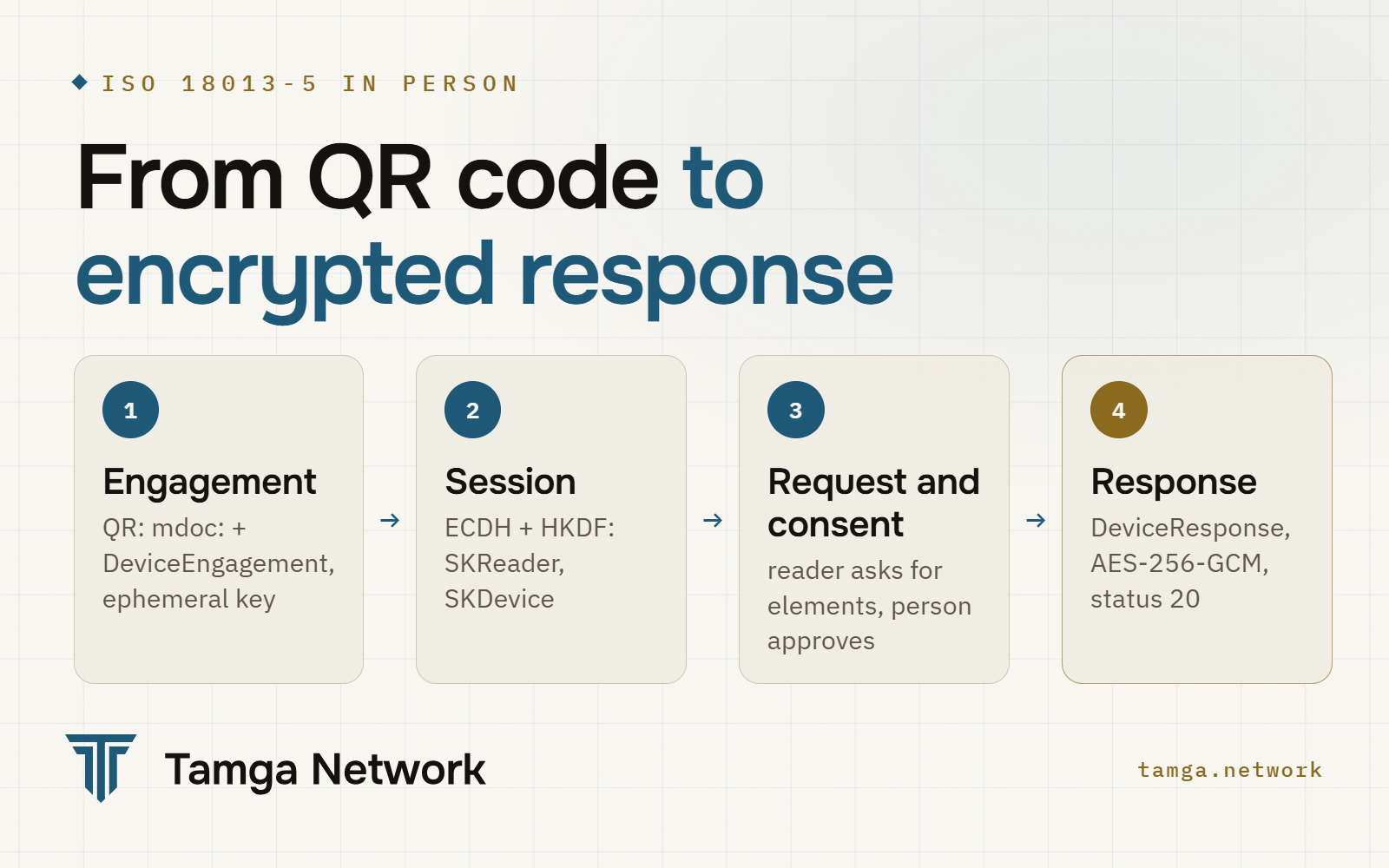
- Device engagement. The wallet creates an ephemeral P-256 key (
EDeviceKey) and a random BLE service UUID, and shows a QR code containingmdoc:followed by base64url of theDeviceEngagementstructure. It holds no personal data. - Session establishment. The reader scans the code, creates its own ephemeral key (
EReaderKey) and derives session keys. Both sides run ECDH, then HKDF-SHA-256 withSHA-256(SessionTranscriptBytes)as salt and the info stringsSKReaderandSKDevice. The reader sendsSessionEstablishment {eReaderKey, data}, wheredatais itsDeviceRequestencrypted under SKReader. - Request and consent. The wallet decrypts the request, shows the requested elements, and the person approves with the phone's lock or declines.
- Response. The wallet sends the
DeviceResponsein aSessionDatamessage encrypted under SKDevice, and ends the session with status20.
{
  0: "1.0",
  1: [1, 24(<< EDeviceKey as COSE_Key >>)],     / cipher suite 1 /
  2: [[2, 1, {                                  / BLE, version 1 /
        0: true,                                / peripheral server mode /
        1: false,                               / central client mode /
        10: h'…16-byte service UUID…'
      }]]
}
Session messages use AES-256-GCM with a 12-byte IV made of an 8-byte identifier (all zeros for the reader, …01 for the device) and a 4-byte message counter that starts at 1. Over BLE the phone acts as a GATT server; each message is split into chunks whose first byte is 0x01 when more follow and 0x00 on the last one.
Status today: the protocol core (engagement, session encryption, BLE framing) is implemented and tested in @tamga-network/mdoc, and the BLE radio is supplied by the wallet app. Device testing is still in progress. NFC is not used; engagement always starts from the QR code. Reader authentication is not included yet, so the wallet tells the person the reader is not verified. Online mdoc presentation over OpenID4VP uses the same request flow as SD-JWT VC.
How does a verifier check an mdoc?
- Parse the
DeviceResponseand confirmdocTypeis the one requested. - Verify
issuerAuth: ES256 only,x5chainresolving to an issuer in the signed trust list, the same anchor used for SD-JWT credentials. - For each disclosed item, hash the tag-24 bytes and compare with
valueDigests[namespace][digestID]. - Check
validityInfoagainst the current time. - Rebuild the SessionTranscript for this request or session, rebuild
DeviceAuthenticationBytes, and verifydeviceSignaturewithdeviceKey. - Read the status bit, then run the same trust, revocation and policy layers as for SD-JWT VC.
The result is the same three-valued outcome: accepted, rejected, or indeterminate when infrastructure can't be reached. The result object never contains raw CBOR or undisclosed elements.
In an OpenID4VP request the mdoc is chosen with DCQL (OpenID4VP and DCQL deep dive): format: "mso_mdoc", meta.doctype_value, and claim paths of the form [namespace, element]:
{
  "credentials": [{
    "id": "identity",
    "format": "mso_mdoc",
    "meta": { "doctype_value": "urn:tamga:id:IdentityAttestation:1" },
    "claims": [{ "path": ["tamga.id.1", "age_over_18"], "values": [true] }]
  }]
}
The mdoc identity credential is also the input to Tamga's zero-knowledge age proof, which works over ordinary ES256-signed mdocs (ADR-0032). The check is live on Tamga Verify; how it works is in Zero-knowledge in Tamga.
Frequently asked questions
Is an mdoc the same as an mDL?
No. An mDL (mobile driving licence) is one document type that uses the mdoc format. Tamga's identity credential is an mdoc with its own docType and namespace, and Tamga's "driving licence information" credential is SD-JWT VC only, not an mDL.
Why are digestIDs random and not sequential?
Sequential IDs would let a verifier infer how many elements a credential has and which positions were withheld. Random 31-bit IDs carry no order.
Can I verify a Tamga mdoc with another ISO 18013-5 library?
The structures are standard ISO 18013-5 and OpenID4VP 1.0. Two points to check: the library must hash tag-24 bytes as received rather than re-encode, and it must support the OpenID4VP handover for online presentations.
Sources
- ISO/IEC 18013-5:2021, Mobile driving licence (mDL) application, ISO
- OpenID for Verifiable Presentations 1.0, Final, 9 July 2025 (Annex B: ISO mdoc)
- OpenID4VC High Assurance Interoperability Profile 1.0, Final, 24 December 2025
- RFC 8949: Concise Binary Object Representation (CBOR), IETF
- RFC 9052: CBOR Object Signing and Encryption (COSE), IETF
- ADR-0013: mdoc for the identity credential, Tamga Network docs
@tamga-network/mdoc, Tamga Network docs- OpenID4VP profile (SPEC-PROTO-0002), Tamga Network docs
- Presentation, Tamga Network docs
Related
- Post · StandardsSD-JWT VC deep dive: signing, disclosures, KB-JWTHow an SD-JWT VC is built and checked byte by byte - salted digests, _sd, cnf, the KB-JWT and sd_hash, vct#integrity and status - with Tamga's profile.
- Post · StandardsOpenID4VP and DCQL deep dive: request to verdictHow a verifier requests and checks credentials with OpenID4VP 1.0: x509_hash signed requests, DCQL, encrypted direct_post.jwt, the A–E pipeline.
- Post · PrivacyZero-knowledge in Tamga: Longfellow, circuits, trust listHow Tamga Network checks "over 18" with a Longfellow zero-knowledge proof, why circuits sit in the signed trust list, and what works today.
- Post · StandardsOpenID4VCI deep dive: offers, DPoP, proofs, batchesOpenID4VCI 1.0 issuance in Tamga: offers and tx_code, PAR and PKCE, DPoP, the nonce endpoint, key proofs, wallet attestation, batches of 10.
- Post · StandardsHAIP and Token Status List: high assurance without trackingWhat HAIP 1.0 fixes and how Tamga applies it, and how Token Status List revokes credentials without telling the issuer where they are used.
Build on the network
Learn the concepts from scratch, or see how an institution, verifier, wallet or state joins.