How a signed trust list works, from registration to check
How Tamga Network's signed trust lists work: two levels, signing, publication cadence, freshness, the anchor log and what a verifier checks.
Tamga Network 8 min read
A signed trust list is a file, signed by the list operator, that says which institutions may issue which credential types, which verifiers are registered and which wallet providers are recognised. Tamga Network publishes two levels of them: a list of trusted lists (lotl.jws) and a country list for Türkiye (tl-tr.jws). A verifier trusts one root fingerprint up front, checks the signatures, the version chain and the freshness of the lists, and then asks one question about each credential: was this institution registered and authorised for this credential type when it signed it?
What are the two levels of lists?
The model is the EU's. The European Commission publishes a list of the member states' trusted lists (EU LOTL) and each state publishes its own national list, in the format set by Commission Implementing Decision (EU) 2015/1505 and ETSI TS 119 612. Tamga follows the same shape:
| List | What it holds | Address |
|---|---|---|
| List of trusted lists (LOTL) | addresses and signing keys of the country lists, wallet providers, the schema catalogue, accepted zero-knowledge circuits | trust.tamga.network/lotl.jws |
| Country list | that country's root certificates, institutions and verifiers | trust.tamga.network/tl-tr.jws |
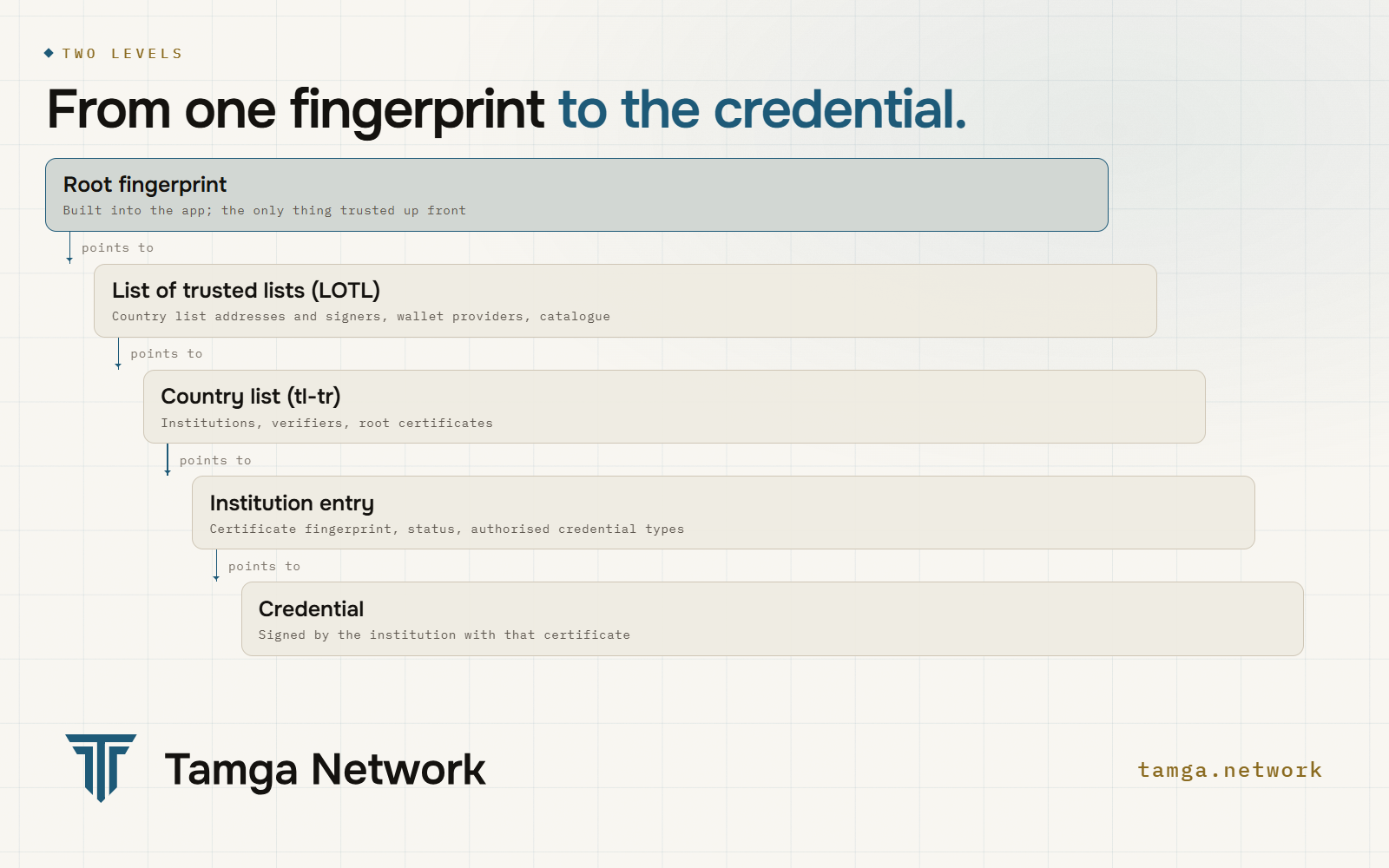
The chain starts with something the verifier already has: the SHA-256 fingerprint of the certificate that signs the LOTL, built into its configuration. The fingerprint is published at tamga.network/trust-anchor. The list server itself is not trusted. Downloading a list from the right address is not enough; its signature has to match that fingerprint.
The LOTL then names the signer of each country list. Today the Türkiye list is the only active one, run provisionally by Tamga on behalf of the national authority; the data structures already carry slots for other states.
What is in an institution's entry?
{
  "issuer_id": "0x5be1…",
  "slug": "example-uni",
  "legal_name": "Example University",
  "category": "EDUCATION",
  "class": "EAA",
  "assurance": "I2",
  "cert_fingerprint_sha256": "a41f…",
  "status": "ACTIVE",
  "valid_from": "2026-10-01T00:00:00Z",
  "valid_until": "2028-10-01T00:00:00Z",
  "status_history": [
    { "status": "ACTIVE", "since": "2026-10-01T00:00:00Z", "reason": "initial-registration" }
  ],
  "schema_authorizations": [
    {
      "vct": "urn:tamga:edu:DiplomaCredential:1",
      "allowed": true,
      "valid_from": "2026-10-01T00:00:00Z",
      "valid_until": null
    }
  ],
  "status_list_base": "https://status.tamga.network/"
}
A few fields carry most of the weight:
issuer_idis computed from the fingerprint of the institution's certificate, so it cannot be chosen or copied.classsays what kind of credential the institution issues: a public-body credential (PUB), a qualified one (QUALIFIED) or an ordinary attestation (EAA).assuranceis its assurance level,I1toI3.schema_authorizationslists the credential types the institution may issue, each with its own time window. A ticket seller with a valid entry still cannot issue a diploma that passes.status_historyis appended to, never rewritten.
What the entry does not contain is just as deliberate: no names of students, no credential hashes, no counts. The rule is that no list, anchor log or change log carries personal data (TL11).
How does an institution get into the list?
An institution applies with its registration data and a certificate signing request. The registrar checks the application and reports every missing field at once; the root certificate authority signs the institution's certificate; the institution is added and the list is re-signed. The change is live within 24 hours. The steps from the institution's side are in How an institution joins Tamga Network.
At every publication the publisher also generates a registration certificate (ETSI TS 119 475) for each verifier use and each issuer, under trust.tamga.network/wrprc/. Its content comes only from the signed list, so a wallet can check a verifier's registration with it as well.
How is a list signed and published?
Each list is a compact JWS signed with ES256, with the operator's certificate in the x5c header. A .json copy sits next to it for people to read; software uses only the .jws.
Three rules keep the history honest:
- The version only grows. An old version cannot be served again as if it were new.
- Each version carries the hash of the previous one (
previous_version_hash), so the versions form a chain and a gap or a rewrite shows. - Nothing is deleted. A withdrawn institution stays in the list with a new status; earlier versions stay in
archive/.
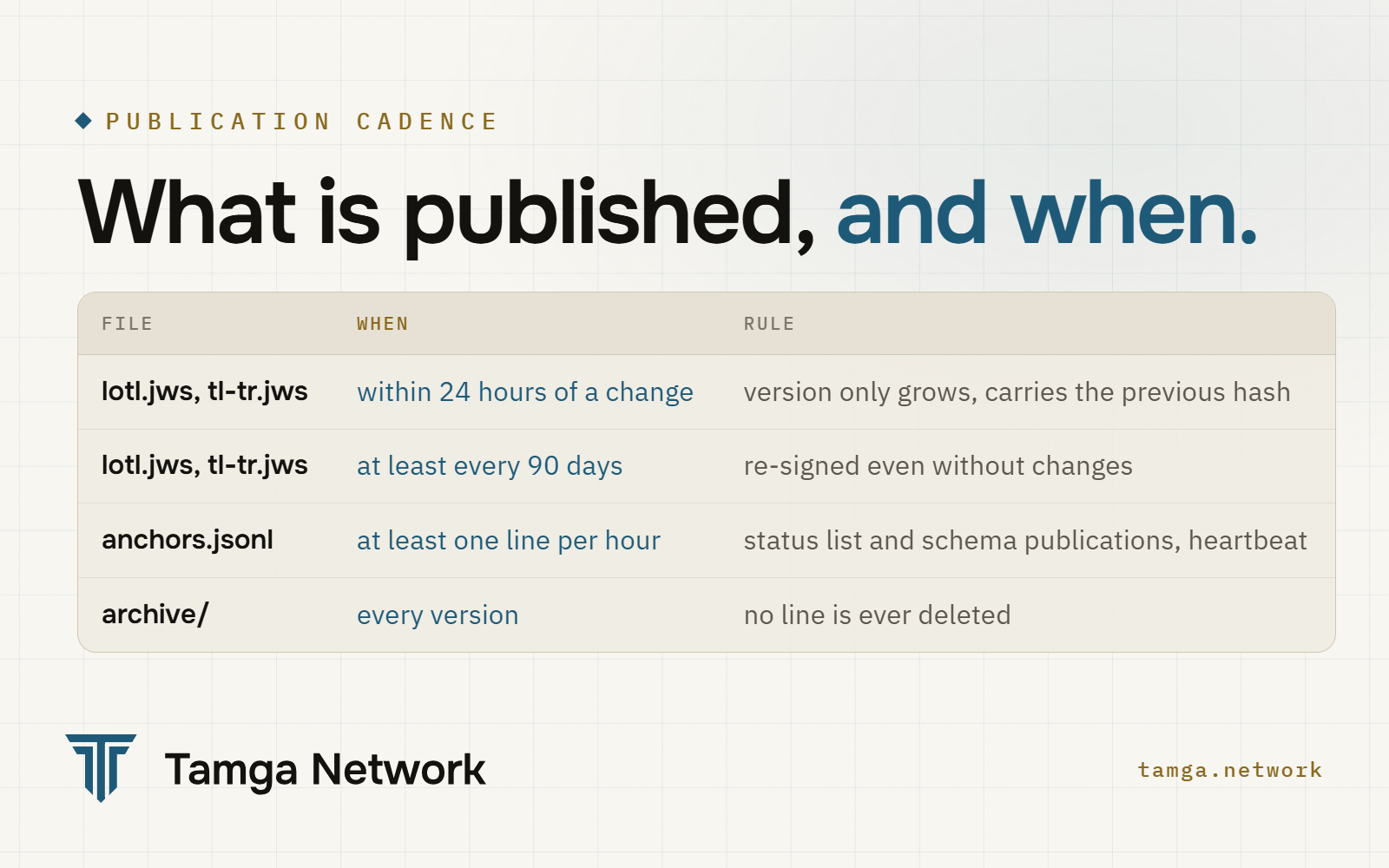
Lists are re-signed at least every 90 days even when nothing changed, so a reader can always tell a quiet list from an abandoned one. A public CHANGELOG.md in the same place records every build.
What is the anchor log for?
Some things change too often to re-sign the whole list each time, above all the revocation lists that institutions publish. These go into anchors.jsonl, the anchor log: one signed line per event, each linked to the previous line by its hash.
A line records, for example, that an institution published version N of its revocation list with a given content hash. When a verifier later reads that revocation list, it compares the hash with the anchor. If the hash does not match or the version went backwards, the credential does not pass; if the verifier's cached copy is simply older than the newest anchor, the result is "cannot be verified right now" until it refreshes. This is how a verifier knows that a revocation list really comes from the institution and has not been swapped for an older one.
The log gets at least one line an hour, with a heartbeat line if nothing else happened. When it grows past 500 lines, the operator moves the lines into the archive and starts the new log with a signed checkpoint that links to the archive's last line and to the archive file's hash. No line is ever deleted, and the full history can be rebuilt from the archives.
How fresh must a list be?
Every list carries next_update. Services reload the lists at regular intervals, and verifiers fetch revocation lists ahead of time and keep them in a cache. Nothing is downloaded at the moment of a check, which is also why the institution never learns where its credentials are shown (Revocation without tracking).
If a list cannot be fetched, or its next_update has passed, the verifier does not guess. The result is "cannot be verified right now" (INDETERMINATE), never accepted and never rejected (TL5). A diploma is not declared fake because a server was unreachable.
What does a verifier check, step by step?
The checks come in two groups. First, when the lists load:
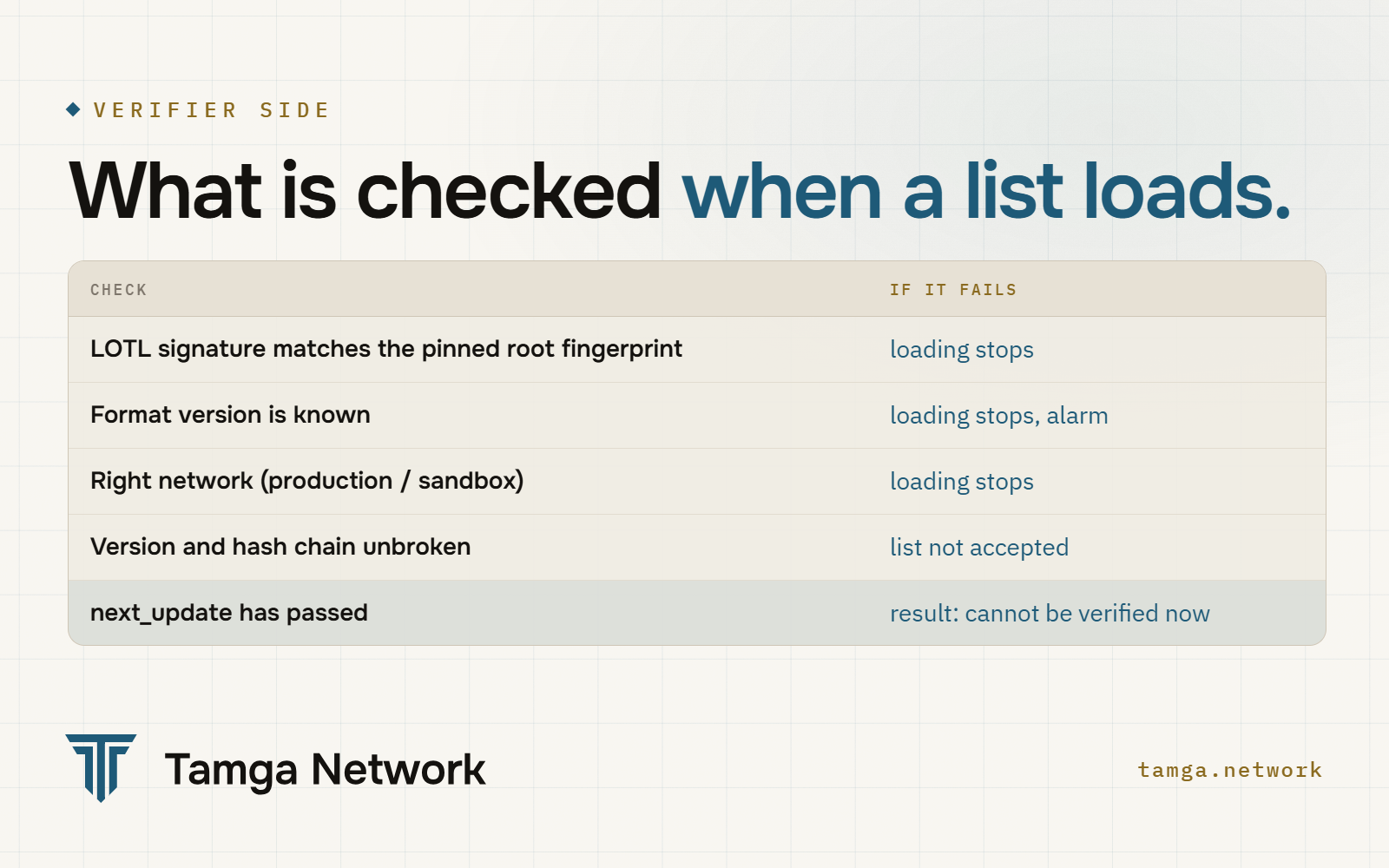
The network check matters for testing: the sandbox's lists say "environment": "sandbox", and a verifier set up for the real network stops on them. A sandbox credential cannot pass at a real verifier.
Then, for each credential, the trust layer of the verification pipeline (verification API) asks:
| Step | Question |
|---|---|
| A3b | Which institution is this? Derived from the certificate that signed the credential; what the credential claims about itself is ignored |
| C1 | Was the institution acceptable at the moment the credential was issued? |
| C2 | Was it authorised for this credential type at that moment? This step cannot be switched off |
| C3 | Does the verifier's country recognise the institution's country? |
| D5 | Does the revocation list match its anchor in the log? |
C1 and C2 look at the credential's issue time, not at today. If a university's entry is later retired, diplomas it issued while active stay valid. If its key was compromised, the entry is revoked with an invalidates_from date, and only credentials from that date on fail. Verification is about the past: what counted is the state of the list on the day of issue.
Code never interprets the list files directly. The @tamga-network/trust package exposes one interface, TrustSource, which answers YES, NO or UNKNOWN; UNKNOWN becomes INDETERMINATE. How to use it: Read the trust lists.
What are the honest limits today?
- One signer. The anchor rests on a single operator's signature. If the operator and an institution acted together, they could show different versions to different readers. The public log, the change log, a quarterly transparency report and independent audit deter this; they do not make it impossible. The shared ledger, which needs at least two independent operators, is what closes this gap (Why we start without a blockchain).
- One key for now. The rules ask for at least two rolling signing certificates, with rotations announced 30 days ahead. The live lists use one; the second key and a key-management service are scheduled before the pilot.
- No ETSI XML yet. The fields map to ETSI TS 119 612 and the statuses have an ETSI mapping, but the XML export is still on the open-issues list. ETSI TS 119 602 views for wallet providers can be published when enabled.
Frequently asked questions
Can I read the trust list myself?
Yes. trust.tamga.network/tl-tr.json and lotl.json are readable copies. Software should load the signed .jws files through TrustSource, which checks the signature, the chain and the freshness.
Does the trust list contain personal data?
No. It holds institution and verifier names, certificate fingerprints, statuses, dates, addresses and credential types. People, credential contents and credential hashes are not in it.
What happens when an institution leaves the network?
Its entry is not removed. The status changes (for example to RETIRED or REVOKED) and the change is appended to its history, so credentials issued earlier can still be judged by the state of the list on their issue date.
How often is the list updated?
A change is published within 24 hours, and every list is re-signed at least every 90 days. The anchor log gets a new line at least every hour.
Is this the same as an EU trusted list?
It follows the same two-level model, and its fields map to ETSI TS 119 612. It is not an EU list: no EU body publishes it, and Tamga does not claim EU status for it.
Sources
- EU list of trusted lists (LOTL, XML)
- Commission Implementing Decision (EU) 2015/1505: trusted list formats
- ETSI TS 119 612 V2.3.1: Trusted Lists
- ETSI TS 119 602 V1.1.1: Lists of trusted entities
- IETF Token Status List (OAuth working group draft)
- Tamga Network: trust list specification · Trust lists and federation · Read the trust lists
- Trust lists · Federation
Related
- Post · NetworkWhat is a trust network, and what does Tamga Network do?A trust network publishes signed lists of who may issue and check digital credentials. What Tamga Network does, what it does not do, where to start.
- Post · NetworkHow an institution joins Tamga NetworkHow an institution joins Tamga Network: try it in the sandbox, apply with registration data and a CSR, get listed, issue the first credential.
- Post · NetworkAdd "verify with Tamga" to your website or appTwo ways to check Tamga credentials on your site or app: the hosted verifier with a page kit, or your own server with @tamga-network/verifier.
- Post · NetworkWhy we start without a blockchainA ledger run by one operator is a slower database. Tamga starts with signed trust lists, the EU model, and adds a ledger once independent operators join.
Build on the network
Learn the concepts from scratch, or see how an institution, verifier, wallet or state joins.